
William H.H. Cash, Civil War veteran, was a very interesting
- and colorful - member of our ancestral Cash family line.
A Cash cousin, Cyndi, sent me a link to a site with a portrait of him. He's on the right in the second row. It's from a book called "Historical atlas of Wisconsin...", published in 1878.
- and colorful - member of our ancestral Cash family line.
A Cash cousin, Cyndi, sent me a link to a site with a portrait of him. He's on the right in the second row. It's from a book called "Historical atlas of Wisconsin...", published in 1878.
◄ I've cropped it and here's what it shows for him. Because he was born in 1843, he would have been 35 when this was published.

◄ This portrait of him appeared as part of a group of photos in an 1890 book about Civil War soldiers and prominent citizens. He would not have been older than 47 when this was published.
(Click on photos and articles to enlarge them, sometimes twice to make articles readable.)
We have articles/records saying he had little formal education, and that
- among other things - during his lifetime he:
■ Was the husband of three wives
■ Was the father of nine children
■ Was a private in the Union army during the U.S. Civil War
■ Was part of the famous General Sherman's army during that war
■ Participated in “Sherman’s march to the sea”
■ Was in the army when Abraham Lincoln was assassinated
■ Was past commander of the Grand Army of the Republic (G.A.R.) post No. 61
■ Was aid-de-camp (sic) of what was called the Department Commander's staff (referring to the G.A.R.) with the rank of Colonel
■ Was a member of the Soldiers' Relief Commission after the war
■ Was owner of a meat market and general store
■ Was an Indian trader
■ Was a contractor who built, owned and operated railroads
■ Was a speculator in various commodities
■ Was a rancher who owned large herds of cattle and sheep
■ Was a speculator in mining interests
■ Operated the Juneau Electric Company
■ Was a real estate speculator with large holdings
■ Was president of a bank
■ Was president of the Business Mens' Association
■ Was Chief stockholder and president of the Glendale Roller Mill
■ Bought entire issues of municipal bonds for a Chicago bond dealer
■ Was the founder of a town named for him
■ Was a Republican
■ Was a County Board member for many years
■ Was a postmaster
■ Was a Wisconsin state legislator
■ Was a member of the Freemasons
■ Was a member of one of Wisconsin’s pioneer families
■ Years before his death, commissioned the building of the largest monument ever built in the New Lisbon, Wisconsin Cemetery
♦♦♦
A "Rags to Riches (to Rags?)" Story
He apparently became a wealthy man after the war. In fact, cousin Cyndi, sent me an 1888 magazine article about him that contains the following: "On circus day
W. H. H. Cash, the great railroad monopolist of New Lisbon, was in the city. He had just made a few hundred thousand dollars on a railroad contract, and he decided to expend large sums of money in buying dry goods..." (Online here)
Because the 1881 article below mentions his railroad transaction, it appears that it took place no later than 1880. Jones cousin Terry Shawver sent me a link to a group of inflation calculators and I made a computation using them.
Assuming that a "few hundred thousand dollars" would mean at least $300,000, and assuming the inflation rate from 1913 (when the Consumer Price Index, CPI, began) to the present, I learned that $300,000 then would be the equivalent of almost $6.5 million in today's dollars, based upon the CPI. If "few hundred thousand dollars" meant more than $300,000 the number in today's dollars could be significantly larger.
Regardless of the amount involved, it apparently launched his opportunity to become a tycoon of sorts. Not bad for a poor kid with little education (mentioned in the article about him below) who earned $13 per month while in the army (also seen below) and accumulated some savings while doing so.
What seems odd to me in view of the financial success he enjoyed during his lifetime is that he died intestate - without a will - at age 81, and his probate record says his net estate was just $30,000, exclusive of the homestead. An inflation calculation for the period between his death in 1924 and 2010 says $30,000 is the equivalent of $319,000 in today's dollars. Not poverty, obviously, but a surprising decrease from the earlier figure.
♦♦♦
Inducements to Enlist In the Army in the Civil War Era
“Inducements more liberal than those tendered to volunteers now were never offered. The private's regular pay is $13 per month; Government bounty $100; enlistment pay $2. Total for the year, $258.
Every private receives at once, on being mustered into the service, the following moneys:
One month's pay in advance. $13
One-fourth of the Government bounty $25
Enlistment pay $2
Total - $40"
Source: Juneau County Argus, New Lisbon, 24 Jul 1862 (Online here)
♦♦♦
His first marriage was to Georgia Anna Surdam, who was born 12 July 1847 in Saratoga, New York.
From Cash cousin Kathy Shea comes this regarding his marriages:
"He was quite a character. I've heard tell that he was a bit of a cad, but I think I would have liked him. He's the one that I told you was married three times. He married his first wife, Georgia Surdam, in 1865. She divorced him in July of 1899. He married his second wife, Alma Harris, a month later, in August 1899. Alma died in 1909
(I suspect giving birth to their son, Daniel). He married a third time, to Angeline Dodge. She outlived him, dying in 1939 in Jackson, Tennessee, of all places!"

◄ This undated photo of Georgia was provided by cousin Kathy Shea, who is her GG granddaughter.
I estimate by her appearance that Georgia could be about 40 years old here. If correct, this portrait would be circa 1887.

◄ This undated photo of him was also provided by his GG granddaughter, cousin Kathy Shea.
He could be in his mid to late 70s here; if so, the photo would be circa 1920.
♦♦♦
The following 1881 article from the "History of Juneau County" chapter of a book titled, “History of Northern Wisconsin..." provides a brief overview of his life up to that time.
“W.H.H. Cash, speculator, New Lisbon, was born in Belmont Co., Ohio in 1843, where he was reared on a farm, and received but a small amount of schooling. In 1861, he came to New Lisbon, and as he was then a poor boy, he worked at all sorts of jobs until Jan. 4, 1864, when he enlisted in the 10th Wis. L. A., [Light Artillery] and was first assigned to Kilpatrick's Command, of Sherman's Army, afterward to the 12th Wis. L.A., and served until the close of the [U.S. Civil] war.
He then returned to New Lisbon, and as he had saved a little money while in the army, he engaged in mercantile business, keeping a meat market and general provision store about ten years, during which time he always kept his eye open to speculations, dealing extensively with the Indians, of whom he purchased a great many cranberries, blueberries, etc. He also dealt in grain, and in fact, anything he thought would prove profitable.
After quitting the mercantile business, he dealt in live stock (sic), and in 1877 was awarded the contract to build the Necedah branch of the C., M. & St, P. R.R. [Chicago, Milwaukee & St. Paul Railroad], which he completed in a very short time, and as the scheme had proven a financial success, he, in 1878, in partnership with D. Vandercook, under the firm name of Cash & Vandercook, concluded to build a railroad of their own from Sparta to Viroqua, and at once procured the right of way and commenced work, but before completion they sold the same to the C., M. & St, P. R.R., and by so doing cleared quite an amount of this world’s goods.
The town of Cashton, on said road, was laid out and started by Mr. Cash, after whom it was named. After completing the Viroqua branch, Mr. Cash, Sept. 19, 1879, was awarded the contract to build the extension of the Wis. Val. R.R. from Warsaw to Jenny (now Merrill), a distance of eighteen miles, the same to be completed by Jan. 1, 1880. He immediately commenced work, and at eight o’clock, P.M., Dec. 31, 1879, the last rail was laid and the first locomotive run over the road – but not without encountering considerable trouble, as the month of December was a very cold one, and many of the employees were badly frozen. One day, six were compelled to leave the work on account of frozen hands, etc.
The following year, he was engaged in speculating in wood, ties, piles, etc., and in the Fall (sic) of said year he started a stock ranch in Iowa and one in Nebraska, where he now has about 600 head of cattle and about 1,000 sheep. The present year, 1881, he has been investing in mining interests in Michigan, Wisconsin and Texas, and general speculation.
Mr. Cash is a Republican in politics, was a member of the Assembly of Wisconsin [the state legislature] in 1877, has held various local offices, and is a member of the F. & A. M. [Free and Accepted Masons] He was married in 1865, to Miss (sic) Georgia Surdam, than of New Lisbon, but formerly of New York. They have five children – Charles F., Adelbert B., Jessie M., John Avery and William N.”
[Editor's comment: In that era, being Republican was common among our northern ancestral family (we also had a southern branch) because the Republican party was formed primarily in opposition to slavery. Democrats in that era were pro-slavery, and these views dominated politics, even after the Emancipation Proclamation became law.]
Source: Article provided by cousin Kathy Shea
♦♦♦
(Editor's comment: Our family is extremely fortunate because extensive research has been done on our ancestral Cash family line. Furthermore, that research – along with documentation of its sources – is available online, thanks to Kathy Shea. Here’s an abbreviated/simplified portion of the data she provided.)
Jonathan Cash
▼
Two of his sons were Hezekiah and William Galen Cash.
▼
Two of their children were William Henry Harrison Cash and Leona D Cash (who was my generation's maternal great grandmother).
WHH Cash was WG Cash’s nephew - and Leona Cash’s 1st cousin. An online Cousin Calculator tells us WHH Cash was also my generation’s 1st cousin 3 x removed. I provide that info to establish our family’s relationship with him. Following is the rest of the story.
♦♦♦
Kathy has uploaded information on Cash and Cash-related families to a site called Rootsweb - and her extensive database includes more than 6,500 names. It’s really amazing!
Beyond that, she’s also created a blog that provides access to a large number of family photographs, along with information about and photos of many family grave sites. The work she’s done has to have taken untold hours – and I’m very grateful for all that she’s done - and her willingness to share it!
Having said all that, I’m taking advantage of the information she’s provided - as well as some provided by Cash cousin Cyndi and research I've done - to focus on WHH Cash, whom I find particularly interesting.
♦♦♦
Here are the details of the family connections. I'll start his story with his grandfather:
■ Name: Jonathan Cash
■ Birth: 02 Oct. 1801 in Maryland
■ Residence: 1803 Ohio
■ Residence: 1840 – 1874, Flushing Township, Belmont County, Ohio,
■ Occupation: Farmer
■ Death: 29 Mar. 1874 in Flushing Township, Belmont County, Ohio
■ Burial: Belmont Ridge Cemetery, Belmont County, Ohio
He married twice, the first time to Mary Stotlar, who was born 17 April 1801 in Virginia. They were married on 10 September 1822 in Belmont County, Ohio, and had six children. Two of them were Hezekiah Cash and William Galen Cash.
Hezekiah Cash b: 21 Oct. 1822 in Belmont County, Ohio
Henry T. Cash b: 11 Aug. 1826 in Guernsey County, Ohio Isai
Isaiah Cash b: Jan. 1835 in Flushing Township, Belmont County, Ohio
Jonathan Cash b: 15 Nov. 1838 in Ohio
Rezin Cash b: 30 Jan. 1842 in Flushing Township, Belmont County, Ohio
William Galen Cash b: 11 Oct. 1847 in Belmont County, Ohio
W.G. Cash married Mary Elizabeth Anderson; they became the parents of Leona Cash Jones;
▼
Leona married Fleetwood Churchill Jones; they became the parents of Carleton D. Jones;
▼
Carleton married Nelle Virginia Field; they became the parents of Fleeta Claire, Paul Wesley, DeRand and Virginia Lee Jones;
▼
Fleeta Claire, Paul Wesley, and Virginia Lee Jones were/are my generation's parents.
♦♦♦
Meanwhile, W.G.’s brother, Hezekiah Cash, married twice, the second time being to Sarah Ann Jones, who was born 14 January 1824 in Harrison, Ohio. They were married 20 October 1842 in Harrison, Ohio and had twelve children.
The eldest was William Henry Harrison Cash, our subject. Here are Hezekiah and Sarah’s children:
William Henry Harrison Cash, born 19 July 1843 in Flushing Township, Belmont County, Ohio.
Eliza Cash b: 1844 in Ohio
John W. Cash b: 19 Oct. 1845 in Belmont County, Ohio
Mary Ann Cash b: Jul. 1847 in Flushing Township, Belmont County, Ohio
Harvy Cash (sic) b: Mar. 1849 in Belmont County, Ohio
Emeline Cash (sic) b: 25 Oct. 1851 in Belmont County, Ohio
Martha Jane Cash b: 28 Jan. 1854 in Belmont County, Ohio
Andrew Jackson Cash b: 09 Mar. 1856 in Harrison, Hamilton County, Ohio
Samuel Franklin Cash b: 19 Jul. 1860 in Belmont County, Ohio
Jeremiah Cash b: 1861 in Ohio
Susan Ella Cash b: Apr. 1865 in New Lisbon, Juneau County, Wisconsin
Jonathan Cash b: 06 Sep. 1867 in New Lisbon, Juneau County, Wisconsin
♦♦♦
Following are several articles and website sources that have to do with W.H.H. Cash:
A Few Good Men of Wisconsin
"W. H. H. CASH of New Lisbon, was born in Belmont county, Ohio, July 19, 1843, where he lived until the Fall (sic) of 1861, receiving a limited education at the public schools, and engaging in farming pursuits. In 1861 he moved to Juneau county, Wis., and settled at New Lisbon, and occupied his time mostly in speculations in real estate.
In January, 1864, he became attached to the Tenth Wisconsin Artillery, in which he served in General Kilpatrick's cavalry division in Sherman's celebrated "march to the sea." At the close of the war he returned to New Lisbon, where he has since been engaged in the produce and live stock (sic) business and in speculating in real estate.
As a strong and reliable Republican, he was brought forward in the fall of 1876 by his fellow-citizens as a candidate for the legislature, and elected by a handsome majority. Mr. Cash is a man of fine habits, strong character, and sterling principle, and will, without doubt, in future years receive yet other honors at the hands of his fellow-citizens."
Source: A Few Good Men of Wisconsin including Biographical Sketches and Early County Histories - 1878 (Online here)
♦♦♦
Pioneer Families of Wisconsin
Ancestor - Male, Birth, Death, Spouse
CASH, Hezekiah 21 Oct. 1822, OH, 1881, JONES, Sarah A.
CASH, William H. Harrison 1843, OH, 1924, SURDOM, Georgia (sic)
Source: The above is extracted from the book "Some Pioneer Families of Wisconsin, An Index" (Online here)
♦♦♦
Juneau Co., Wisconsin, Civil War Veterans
Name, Company, Rank, Years of Service
Cash, W. H. H., 10th Btry Wis Lgt Arty [light artillery], Pvt , Jan 1864-June 1865
(Source)
♦♦♦
Wisconsin Census Enumeration - 1895 (Juneau County only)
Names of Ex-Soldiers and Sailors Residing In Wisconsin
June 20, 1895
Name, Rank, Co., Regt., Branch of Service, Post Office
Cash, W. H. H., Private, 10 Battery, New Lisbon
(Source)
♦♦♦
Mauston Star, April 10, 1890
"The Soldiers' Relief Commission, P. R. Briggs, W. H. H. Cash and John Jenewein, on Monday apportioned the following amount of money to those in need of help:
Mrs. John Allison, Mauston -- $5.00
C. M. Ward, Mauston -- $5.00
H. O. Carter, Mauston -- $5.00
Henry Colburn, Wonewoc -- $5.00
William Miller, Wonewoc -- $5.00
Thos. Stevens, Necedah -- $5.00
Chas. Horton, Necedah -- $5.00
George Newland, Mauston -- $5.00
Wilson Brown, Mauston -- $5.00
Caroline Houch, New Lisbon -- $5.00
Emily Smith, New Lisbon -- $5.00"
(Source)
♦♦♦

◄ This 1909 letter from WHHC was written to his cousin, Etta Cash Jester, and was provided by Cash cousin Cyndi, who was Etta's great granddaughter.
♦♦♦
Cut Down Ridge, Close Old Feud Between Towns
Indian Trail Over Wood Hill Gap to Become Trunk Highway;
Cost Set at $18,000
The Milwaukee Journal, 19 Nov 1922
The old Indian trail over the Dividing Ridge in Juneau County known as the Wood hill gap, after 40 years of agitation is to come into its own as a county trunk highway.
A big force of workers is engaged in cutting down the hill, making a grade 2,400 feet long with a percentage ranging from 5 to 7 per cent. The work will cost about $18,000 and with good weather, will be completed this fall.
The cutting down of Wood hill will provide a short cut from highway 33 over highway 94 and the new route between Union Center and New Lisbon and will enable travelers going into the north and northeast parts of the state to cut over highways 12 and 21.
The Dividing Ridge, which runs in an eastern and westerly direction through Juneau and Monroe Counties, is one of the most prominent elevations in the state. Its summit is 125 feet high and the ridge is so sharp that in the early days it could be crossed only at the gaps or breaks in it. The railroads when they went through this section tunneled the ridge.
TOWN RIVALRY ARISES
More than 70 years ago the state legislature passed a law providing for a highway from Mineral Point up the Wisconsin River valley to Wisconsin Rapids. The surveyors located the Wood hill gap and ran the road through it. A little grading was done then but the hill remained so steep as almost to destroy the usefulness of this highway.
Then when the state highway system was begun, a rivalry sprang up between the faction backing the Goodenough hill gap to the east and the faction advocating that the state highway be made over the Wood hill. The question became one of the burning issues in Juneau County and was mixed up with the rivalry between Mauston, the present county seat, and New Lisbon, which has long had aspirations to be the county town.
The Goodenough hill group won and highway 12 was made through that gap. More than $50,000, it is said, has been spent in cutting down Goodenough hill and the work is not yet completed. But the advocates of the Wood Hill route did not rest. They were headed by W. H. Cash, New Lisbon, railroad builder, and one of the best known men in this section.
MAY OPEN BUS LINE
"Although I am 80," said Mr. Cash, "I swore that I would live to see the Wood hill route put through. The gap that was good enough for the Indians and for our forefathers is good enough for us. So we got an appropriation of $8,000 made to the township of Plymouth and a year later another appropriation of $6,000. I then had my son, Fred Cash, a railroad engineer, survey the route and finally we got the work started. Nothing will add so greatly to the road facilities in this section and the convenience of travelers coming through here as the making of the Wood hill route."
Mr. Cash, according to reports, is planning a bus line as soon as the route is completed to run north and south from Necedah to Elroy and east and west from Mauston to Camp Douglas. This line will center at New Lisbon.
Source: Article provided by cousin Kathy Shea (online here)
♦♦♦

◄ Article provided by cousin Kathy Shea
He could be in his mid to late 70s here; if so, the photo would be circa 1920.
♦♦♦
The following 1881 article from the "History of Juneau County" chapter of a book titled, “History of Northern Wisconsin..." provides a brief overview of his life up to that time.
“W.H.H. Cash, speculator, New Lisbon, was born in Belmont Co., Ohio in 1843, where he was reared on a farm, and received but a small amount of schooling. In 1861, he came to New Lisbon, and as he was then a poor boy, he worked at all sorts of jobs until Jan. 4, 1864, when he enlisted in the 10th Wis. L. A., [Light Artillery] and was first assigned to Kilpatrick's Command, of Sherman's Army, afterward to the 12th Wis. L.A., and served until the close of the [U.S. Civil] war.
He then returned to New Lisbon, and as he had saved a little money while in the army, he engaged in mercantile business, keeping a meat market and general provision store about ten years, during which time he always kept his eye open to speculations, dealing extensively with the Indians, of whom he purchased a great many cranberries, blueberries, etc. He also dealt in grain, and in fact, anything he thought would prove profitable.
After quitting the mercantile business, he dealt in live stock (sic), and in 1877 was awarded the contract to build the Necedah branch of the C., M. & St, P. R.R. [Chicago, Milwaukee & St. Paul Railroad], which he completed in a very short time, and as the scheme had proven a financial success, he, in 1878, in partnership with D. Vandercook, under the firm name of Cash & Vandercook, concluded to build a railroad of their own from Sparta to Viroqua, and at once procured the right of way and commenced work, but before completion they sold the same to the C., M. & St, P. R.R., and by so doing cleared quite an amount of this world’s goods.
The town of Cashton, on said road, was laid out and started by Mr. Cash, after whom it was named. After completing the Viroqua branch, Mr. Cash, Sept. 19, 1879, was awarded the contract to build the extension of the Wis. Val. R.R. from Warsaw to Jenny (now Merrill), a distance of eighteen miles, the same to be completed by Jan. 1, 1880. He immediately commenced work, and at eight o’clock, P.M., Dec. 31, 1879, the last rail was laid and the first locomotive run over the road – but not without encountering considerable trouble, as the month of December was a very cold one, and many of the employees were badly frozen. One day, six were compelled to leave the work on account of frozen hands, etc.
The following year, he was engaged in speculating in wood, ties, piles, etc., and in the Fall (sic) of said year he started a stock ranch in Iowa and one in Nebraska, where he now has about 600 head of cattle and about 1,000 sheep. The present year, 1881, he has been investing in mining interests in Michigan, Wisconsin and Texas, and general speculation.
Mr. Cash is a Republican in politics, was a member of the Assembly of Wisconsin [the state legislature] in 1877, has held various local offices, and is a member of the F. & A. M. [Free and Accepted Masons] He was married in 1865, to Miss (sic) Georgia Surdam, than of New Lisbon, but formerly of New York. They have five children – Charles F., Adelbert B., Jessie M., John Avery and William N.”
[Editor's comment: In that era, being Republican was common among our northern ancestral family (we also had a southern branch) because the Republican party was formed primarily in opposition to slavery. Democrats in that era were pro-slavery, and these views dominated politics, even after the Emancipation Proclamation became law.]
Source: Article provided by cousin Kathy Shea
♦♦♦
(Editor's comment: Our family is extremely fortunate because extensive research has been done on our ancestral Cash family line. Furthermore, that research – along with documentation of its sources – is available online, thanks to Kathy Shea. Here’s an abbreviated/simplified portion of the data she provided.)
Jonathan Cash
▼
Two of his sons were Hezekiah and William Galen Cash.
▼
Two of their children were William Henry Harrison Cash and Leona D Cash (who was my generation's maternal great grandmother).
WHH Cash was WG Cash’s nephew - and Leona Cash’s 1st cousin. An online Cousin Calculator tells us WHH Cash was also my generation’s 1st cousin 3 x removed. I provide that info to establish our family’s relationship with him. Following is the rest of the story.
♦♦♦
Kathy has uploaded information on Cash and Cash-related families to a site called Rootsweb - and her extensive database includes more than 6,500 names. It’s really amazing!
Beyond that, she’s also created a blog that provides access to a large number of family photographs, along with information about and photos of many family grave sites. The work she’s done has to have taken untold hours – and I’m very grateful for all that she’s done - and her willingness to share it!
Having said all that, I’m taking advantage of the information she’s provided - as well as some provided by Cash cousin Cyndi and research I've done - to focus on WHH Cash, whom I find particularly interesting.
♦♦♦
Here are the details of the family connections. I'll start his story with his grandfather:
■ Name: Jonathan Cash
■ Birth: 02 Oct. 1801 in Maryland
■ Residence: 1803 Ohio
■ Residence: 1840 – 1874, Flushing Township, Belmont County, Ohio,
■ Occupation: Farmer
■ Death: 29 Mar. 1874 in Flushing Township, Belmont County, Ohio
■ Burial: Belmont Ridge Cemetery, Belmont County, Ohio
He married twice, the first time to Mary Stotlar, who was born 17 April 1801 in Virginia. They were married on 10 September 1822 in Belmont County, Ohio, and had six children. Two of them were Hezekiah Cash and William Galen Cash.
Hezekiah Cash b: 21 Oct. 1822 in Belmont County, Ohio
Henry T. Cash b: 11 Aug. 1826 in Guernsey County, Ohio Isai
Isaiah Cash b: Jan. 1835 in Flushing Township, Belmont County, Ohio
Jonathan Cash b: 15 Nov. 1838 in Ohio
Rezin Cash b: 30 Jan. 1842 in Flushing Township, Belmont County, Ohio
William Galen Cash b: 11 Oct. 1847 in Belmont County, Ohio
W.G. Cash married Mary Elizabeth Anderson; they became the parents of Leona Cash Jones;
▼
Leona married Fleetwood Churchill Jones; they became the parents of Carleton D. Jones;
▼
Carleton married Nelle Virginia Field; they became the parents of Fleeta Claire, Paul Wesley, DeRand and Virginia Lee Jones;
▼
Fleeta Claire, Paul Wesley, and Virginia Lee Jones were/are my generation's parents.
♦♦♦
Meanwhile, W.G.’s brother, Hezekiah Cash, married twice, the second time being to Sarah Ann Jones, who was born 14 January 1824 in Harrison, Ohio. They were married 20 October 1842 in Harrison, Ohio and had twelve children.
The eldest was William Henry Harrison Cash, our subject. Here are Hezekiah and Sarah’s children:
William Henry Harrison Cash, born 19 July 1843 in Flushing Township, Belmont County, Ohio.
Eliza Cash b: 1844 in Ohio
John W. Cash b: 19 Oct. 1845 in Belmont County, Ohio
Mary Ann Cash b: Jul. 1847 in Flushing Township, Belmont County, Ohio
Harvy Cash (sic) b: Mar. 1849 in Belmont County, Ohio
Emeline Cash (sic) b: 25 Oct. 1851 in Belmont County, Ohio
Martha Jane Cash b: 28 Jan. 1854 in Belmont County, Ohio
Andrew Jackson Cash b: 09 Mar. 1856 in Harrison, Hamilton County, Ohio
Samuel Franklin Cash b: 19 Jul. 1860 in Belmont County, Ohio
Jeremiah Cash b: 1861 in Ohio
Susan Ella Cash b: Apr. 1865 in New Lisbon, Juneau County, Wisconsin
Jonathan Cash b: 06 Sep. 1867 in New Lisbon, Juneau County, Wisconsin
♦♦♦
Following are several articles and website sources that have to do with W.H.H. Cash:
A Few Good Men of Wisconsin
"W. H. H. CASH of New Lisbon, was born in Belmont county, Ohio, July 19, 1843, where he lived until the Fall (sic) of 1861, receiving a limited education at the public schools, and engaging in farming pursuits. In 1861 he moved to Juneau county, Wis., and settled at New Lisbon, and occupied his time mostly in speculations in real estate.
In January, 1864, he became attached to the Tenth Wisconsin Artillery, in which he served in General Kilpatrick's cavalry division in Sherman's celebrated "march to the sea." At the close of the war he returned to New Lisbon, where he has since been engaged in the produce and live stock (sic) business and in speculating in real estate.
As a strong and reliable Republican, he was brought forward in the fall of 1876 by his fellow-citizens as a candidate for the legislature, and elected by a handsome majority. Mr. Cash is a man of fine habits, strong character, and sterling principle, and will, without doubt, in future years receive yet other honors at the hands of his fellow-citizens."
Source: A Few Good Men of Wisconsin including Biographical Sketches and Early County Histories - 1878 (Online here)
♦♦♦
Pioneer Families of Wisconsin
Ancestor - Male, Birth, Death, Spouse
CASH, Hezekiah 21 Oct. 1822, OH, 1881, JONES, Sarah A.
CASH, William H. Harrison 1843, OH, 1924, SURDOM, Georgia (sic)
Source: The above is extracted from the book "Some Pioneer Families of Wisconsin, An Index" (Online here)
♦♦♦
Juneau Co., Wisconsin, Civil War Veterans
Name, Company, Rank, Years of Service
Cash, W. H. H., 10th Btry Wis Lgt Arty [light artillery], Pvt , Jan 1864-June 1865
(Source)
♦♦♦
Wisconsin Census Enumeration - 1895 (Juneau County only)
Names of Ex-Soldiers and Sailors Residing In Wisconsin
June 20, 1895
Name, Rank, Co., Regt., Branch of Service, Post Office
Cash, W. H. H., Private, 10 Battery, New Lisbon
(Source)
♦♦♦
Mauston Star, April 10, 1890
"The Soldiers' Relief Commission, P. R. Briggs, W. H. H. Cash and John Jenewein, on Monday apportioned the following amount of money to those in need of help:
Mrs. John Allison, Mauston -- $5.00
C. M. Ward, Mauston -- $5.00
H. O. Carter, Mauston -- $5.00
Henry Colburn, Wonewoc -- $5.00
William Miller, Wonewoc -- $5.00
Thos. Stevens, Necedah -- $5.00
Chas. Horton, Necedah -- $5.00
George Newland, Mauston -- $5.00
Wilson Brown, Mauston -- $5.00
Caroline Houch, New Lisbon -- $5.00
Emily Smith, New Lisbon -- $5.00"
(Source)
♦♦♦

◄ This 1909 letter from WHHC was written to his cousin, Etta Cash Jester, and was provided by Cash cousin Cyndi, who was Etta's great granddaughter.
♦♦♦
Cut Down Ridge, Close Old Feud Between Towns
Indian Trail Over Wood Hill Gap to Become Trunk Highway;
Cost Set at $18,000
The Milwaukee Journal, 19 Nov 1922
The old Indian trail over the Dividing Ridge in Juneau County known as the Wood hill gap, after 40 years of agitation is to come into its own as a county trunk highway.
A big force of workers is engaged in cutting down the hill, making a grade 2,400 feet long with a percentage ranging from 5 to 7 per cent. The work will cost about $18,000 and with good weather, will be completed this fall.
The cutting down of Wood hill will provide a short cut from highway 33 over highway 94 and the new route between Union Center and New Lisbon and will enable travelers going into the north and northeast parts of the state to cut over highways 12 and 21.
The Dividing Ridge, which runs in an eastern and westerly direction through Juneau and Monroe Counties, is one of the most prominent elevations in the state. Its summit is 125 feet high and the ridge is so sharp that in the early days it could be crossed only at the gaps or breaks in it. The railroads when they went through this section tunneled the ridge.
TOWN RIVALRY ARISES
More than 70 years ago the state legislature passed a law providing for a highway from Mineral Point up the Wisconsin River valley to Wisconsin Rapids. The surveyors located the Wood hill gap and ran the road through it. A little grading was done then but the hill remained so steep as almost to destroy the usefulness of this highway.
Then when the state highway system was begun, a rivalry sprang up between the faction backing the Goodenough hill gap to the east and the faction advocating that the state highway be made over the Wood hill. The question became one of the burning issues in Juneau County and was mixed up with the rivalry between Mauston, the present county seat, and New Lisbon, which has long had aspirations to be the county town.
The Goodenough hill group won and highway 12 was made through that gap. More than $50,000, it is said, has been spent in cutting down Goodenough hill and the work is not yet completed. But the advocates of the Wood Hill route did not rest. They were headed by W. H. Cash, New Lisbon, railroad builder, and one of the best known men in this section.
MAY OPEN BUS LINE
"Although I am 80," said Mr. Cash, "I swore that I would live to see the Wood hill route put through. The gap that was good enough for the Indians and for our forefathers is good enough for us. So we got an appropriation of $8,000 made to the township of Plymouth and a year later another appropriation of $6,000. I then had my son, Fred Cash, a railroad engineer, survey the route and finally we got the work started. Nothing will add so greatly to the road facilities in this section and the convenience of travelers coming through here as the making of the Wood hill route."
Mr. Cash, according to reports, is planning a bus line as soon as the route is completed to run north and south from Necedah to Elroy and east and west from Mauston to Camp Douglas. This line will center at New Lisbon.
Source: Article provided by cousin Kathy Shea (online here)
♦♦♦

◄ Article provided by cousin Kathy Shea
♦♦♦
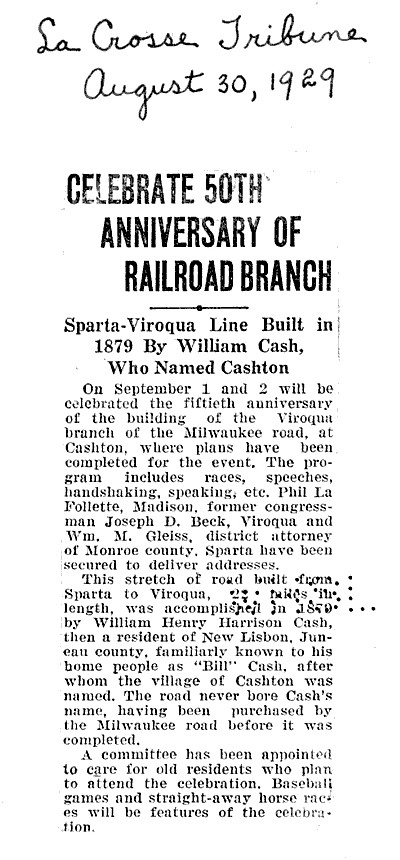
◄ Article provided by cousin Kathy Shea
♦♦♦

◄ Article provided by cousin Kathy Shea
At old soldiers' reunion, “...W.H.H. Cash will steal a mule and forage for the ‘boys’ as he did in 'Sherman’s march to the sea'..."
♦♦♦

◄ Article provided by cousin Kathy Shea
♦♦♦
The Telephone Company
Kathy Shea provided me with an article about the New Lisbon phone company that referred, in passing, to WHH Cash. It said:
“Our Telephone Company
The first telephone system to be built in New Lisbon and vicinity was in the year 1900 when O.G. Loomis and W.H.H. Cash operated the Juneau Electric Company…”
The balance of the article discusses the phone company’s history, and isn’t relevant to our subject. However, in a comment about the phone company, Kathy said the following:
“WHHC was my great, great grandfather.
Yes, he was quite the business man. I'll send you a bunch of articles I have on him.
Of the phone company, my mom says that back in the day they had this new-fangled invention called the telephone, but with little way to get service to customers and with few funds with which to do it. Because WHHC owned the railroad, they approached him about installing phone poles lines to that part of the state and providing service, which he agreed to do, but when they offered him stock in the phone company as a means of payment, he said he wanted cash because the stock would never be worth anything. (That may be why he gained and lost several fortunes during his lifetime. LOL)”
“WHHC was my great, great grandfather.
Yes, he was quite the business man. I'll send you a bunch of articles I have on him.
Of the phone company, my mom says that back in the day they had this new-fangled invention called the telephone, but with little way to get service to customers and with few funds with which to do it. Because WHHC owned the railroad, they approached him about installing phone poles lines to that part of the state and providing service, which he agreed to do, but when they offered him stock in the phone company as a means of payment, he said he wanted cash because the stock would never be worth anything. (That may be why he gained and lost several fortunes during his lifetime. LOL)”
♦♦♦
A Centennial publication put out by the city of New Lisbon states, "In the custom of olden days, able men were of legal mind, often "read law" with qualified members of the bar. While rarely admitted to the bar themselves, they were held in high regard and their opinions, respected. Among this group were W.H.H. Cash......- all of them men of unquestioned ability, who played their part in the shaping of New Lisbon's history.' The same publication lists him as being elected Postmaster on May 27, 1893."
Source
Source
♦♦♦
Here's a link to the monument WHHC had built at the Lisbon City Cemetery
♦♦♦

◄ Cover of the 1890 book about Civil War soldiers referred to in the caption for the photo of the young WHH Cash above
Here's a link to the monument WHHC had built at the Lisbon City Cemetery
♦♦♦

◄ Cover of the 1890 book about Civil War soldiers referred to in the caption for the photo of the young WHH Cash above

◄ A group of portraits in the book, from which the portrait of the young WHH Cash, above, was created

◄ Biographical sketch of WHH Cash which includes details of the battles in which his battallion fought, and other information about his life

◄ Biographical sketch continued
Source
♦♦♦
His Obituary
"W.H.H. Cash, Pioneer Citizen, Dies Suddenly
William Henry Harrison Cash was born in Belmont County, Ohio, on July 19th, 1843, and died in this city of heart failure on Aug. 13th, 1924. He came here with his parents in 1861. In December 1863 he enlisted in the 10th Wis. Battery and under Capt. Y.V. Beebe, and later was transferred to the 12th Wisconsin Battery. He was honorably discharged from the service in Madison on June 7th, 1865.
Returning to New Lisbon he engaged in business and in 1877 was elected as member of assembly of the state legislature. He was the contractor who built the branch line of the C.M.& St. P. Ry from here to Necedah. In 1878 in partnership with D. Vandercook they built what is known as the Viroqua branch from Sparta to Viroqua and before its completion they sold it to the C.M.& St. P. Ry. Co.
The Village of Cashton was laid out by Mr. Cash and named after him. On Sept. 19, 1879 he was awarded the contract of building the roads between Sauk City and Mazomanie, and from Brandon to Markesan, and built roads in Michigan and Nebraska. In company with the Hammer Bros. he built the railroad between Union Center and Hillsboro, and recently purchased the Cazanovia railroad which he was operating at the time of his death.
For many years he was a stockholder in the Glendale Roller Mill Co. For a number of years he has conducted an insurance and coal business in this city. He erected the Cash Block in which the post office is now located. A number of years ago when the government was rounding up the Winnebago Indians and sending [them] to the Nebraska reservation Mr. Cash took an important part in this work.
Besides conducting a meat market here for a number of years in partnership with his father Hezekiah Cash, he also dealt quite extensively in the shipment of blueberries. For some years he bought and sold bonds for bond houses.
As a member of the county supervisors he was elected many times. It was mainly through his exertions that the county poor farm was located here. Before the new state banking laws took effect he conducted a private bank [in] this city for a number of years. He served as postmaster here for 4 years.
Mr. Cash was married three times. He is survived by his present wife and the following children: F.C. Cash and Grant Cash of this city, John Cash of Cazenovia, Willis Cash of Janesville, Burns Cash of Minneapolis, Wade Cash of Baraboo, Mrs. Jessie Stokes of Eau Claire and Mrs. Nettie Kubowsi of Olwein, Iowa. One sister, Mrs. Martha Coughlin of Necedah, and two brothers, Frank Cash of the state of Washington and Jerry Cash of Minnesota, also survive him.
His funeral took place Saturday from the home at 2:30 and M.E. [Methodist Episcopal] Church at 3:00 P.M., Rev. M.R. Philpott officiating. Burial services at the grave were were conducted by brethren of Juneau Lodge No. 103 F. & A.M. of this city. Members of W.P. Mitchell Post No. 61, G.A.R. attended the funeral in a body.
The church edifice was filled with friends from here and adjoining places. Quite a few members of the county board and some county officials were in attendance. All of Mr. Cash's children and their families, and his sister Mrs. Martha Coughlin of Necedah and his niece [actually his granddaughter] Mrs. Harrry Schooff of Dalton attended the obsequies. His casket was draped with an American flag and there were many beautiful floral displays on the bier.
He was laid to rest in the New Lisbon Cemetery. The city flag hung at half mast through the day and all business places were closed during the hour of the funeral.
Source: Kathy Shea's family tree on Ancestry.com, which reports the original source as the New Lisbon newspaper, 21 Aug 1924
Last updated 7/27/2010


