5/30/10

Memorial Day, 1891


The U.S. Civil War ended in 1865. Although it dates back to 1865 and was first called Decoration Day, it wasn't until twenty-six years later, on May 30th, 1891, that the village of Morristown, in Belmont County, Ohio, held its first Memorial Day celebration to honor the Union soldiers who died in that war.

This yellowed article appeared June 1st, 1891, in a newspaper called the REPUBLICAN, and is part of the family history archive assembled by my generation's maternal uncle, DeRand Jones. (Click to enlarge it.)


The reason this article is part of DeRand's archive is that, while the first part of the article describes the events of that Memorial Day in Morristown, the latter part of it references my generation's maternal great, great, grandfather, W.G. Cash. In Belmont County, Cash was a farmer, lay minister, teacher, and ultimately became superintendent of schools in the district. (Via his Cash line our family is reportedly distant cousins of James Cash Penney of JC Penney stores. Another person reports that this Cash line is also related to singer Johnny Cash, but that connection has been broken, subject to further evidence being found,) Here's the descendancy from W.G. to my mother's generation:

William Galen Cash

Leona Cash Jones

Carleton Duane Jones

Fleeta Claire Jones / Paul Wesley Jones / Virginia Lee Jones / DeRand Jones


Present on that Memorial Day were survivors of the Civil War, and it’s very interesting to read about the fervent patriotism of the townspeople in an era in small town America when people knew everyone else in town. They had experienced the horror of a war in which brothers sometimes fought on opposite sides.

Not incidentally, we've identified eleven members of our ancestral family who were soldiers who fought and/or died on both sides of this war. This includes four members of our Cash line.

The second part of the article, which deals with the writer's concerns about the management of the district's schools, refers to W.G. Cash being considered for the superintendency of the schools. It also mentions the fact that there was outrage on the part of some that the compensation of a teacher in the schools had been gradually increased from $25 per month to $50 per month over a seven year period. To put that in perspective, here's a look at some 1891 prices:
Bread: 2¢ / loaf
Milk: 17¢ / gallon
House: $5,500
Average annual income: $650

Below I have transcribed the article.

♦♦♦

SOLDIERS AND SCHOOLS
_____

A Letter Descriptive of Morristown’s First Memorial Day; And Comments Touching the Management of District Schools

Morristown, O, June 1, 1891

Morristown was full of people May 30th who came to witness or take part in the first Memorial services ever held in this place. The Belmont delegation, including quite a number of the G A R and several spring wagons loaded with young ladies arrived about 2 o’clock, headed by the Belmont Cornet band. Drummond Post, No 203 of St, Clairesville was well represented and the decoration services were performed by them assisted by a firing party from Belmont commanded by Comrade Dave Pangle. About half past 2 o’clock the church bells were rang [sic] and the Sabbath schools of the Disciples, Methodist and Presbyterian churches assembled.

[Editor’s comment: For interesting info about G A R, click here. G A R is an acronym for Grand Amy of the Republic. Founded in Decatur, Illinois, membership was limited to honorably discharged veterans of the Union Army, Navy, Marine Corps or Revenue Cutter Service who served between April, 12, 1861 and April, 9, 1865. The American Civil War began on April 12, 1861, and most historians reportdly consider Lee's surrender on April 9, 1865, the end of the war.]

The comrades of the G A R fell in line at the town hall at the command of comrades Baldwin and Landers, after which, headed by the band, they headed to the west end of town, halting at Landers’ grocery where each comrade was presented with a beautiful bouquet and a wreath of evergreens or a pot of flowers for decoration purposes.

The procession then marched down Main Street to Steger’s corner, turning to the left they halted at the Disciples’ church where a neat stand had been erected for the speakers. After the different Sabbath schools had arrived and filed into the church, the services were opened with prayer by Rev. Gaily followed by music by the choir. A recitation, “Mother’s Songs”, was beautifully rendered by Mrs. Geo. McConnaughy. After the song Tenting on the Old Camp Ground, Dr. Hogue, who presided at the meeting, introduced our State Senator, J. W. Nichols, who delivered a stirring address during which he gave a graphic history of the military career of Gen. Sherman, who died since last Memorial day.

After another song by the choir Mr. A. M. Major favored the audience with an appropriate recitation delivered in his best style. Rev. Morton closed the exercises with prayer. The impressive Memorial services of the Grand Army of the Republic were then begun, during which eighteen soldiers’ graves were decorated with flowers.

After firing a salute the boys marched to the hall and broke ranks. The delegation from Belmont kept its organization intact from first to last, and was universally admired, especially the young ladies, who fully sustained the reputation Belmont has always had for being the home of more pretty girls than any other town of its size in the county.

Many dwellings and nearly all the business houses in town, including the mill, displayed the stars and stripes, Mr. Steger’s store leading in that respect. Loydsville and vicinity were the most intensely loyal neighborhood in Belmont County during the [Civil] war. Nearly all the able-bodied men were in the army, and the survivors still remember and like to talk over the days that tried men’s souls.

Many thanks for your attendance and assistance. Come again. Most of the “boys” are gray-haired and none of them as young as they used to be. Soldier William Nichols, who was a good Quaker but a better patriot, and, like Putnam, left his plow in the furrow to defend his country, looks like he could stand another campaign.

Comrades Baldwin, of Loydsville, and Humphrey each wore an empty sleeve, [meaning they’d lost an arm in the war] and J. Michner wore his arm in a sling caused by a recent injury to his shoulder. Harry Nichols looks better than he did twenty-five years ago when he quit boarding at the hotel Wirtz, Andersonville, Ga. [This is a reference to the Confederates' notoriously horrible prisoner of war stockade in Andersonville, Georgia, and its superintendent, Henry Wirtz, who was tried and hanged by a military court after the war. Click
here for more about Andersonville and Wirtz.]

There is some talk of establishing a post of the G A R at Morristown.

♦♦♦

The toll gate school house will be torn down at the close of the spring term, and replaced by a larger and more convenient house.

The friends of our public school are anxiously awaiting the actions of our board in the employment of a superintendent for the coming year. Mr. W. G. Cash who has had charge of our schools the past year is an experienced teacher and has certainly raised the standard of our schools. He taught his home school, the Essex in Flushing Township, about eight years in succession and left it by long odds the best school in the township.

Our schools have gotten down to such a low grade that a few boys that came from country district schools, were our best scholars, and there has been some complaint about having advanced classes for pupils from other districts. Gentlemen, this ought not to be the case. A graded school should be better than any district school, and the way to make it better and keep it better is to employ a good teacher and keep him by paying him a liberal salary, and assuring him of the permanence of his position by employing him promptly at the close of one year’s school to teach the next year.

We have a good example of the advantages of permanence, in sub-district No. 5, Union township. The school is known as Spring Grove. Seven years ago when the present teacher, Mr. Brown, was first employed the school enjoyed a reputation second to none for low scholarship and bad government. A teacher was seldom kept more than one term, and he was lucky if he did not have a case of assault to settle before a justice of the peace, Of course some of the brightest pupils learned fairly well but the influence of the school was bad on all alike.

The first year Mr. Brown was engaged at the end of each term to teach the next. After that he has been engaged by the year, nearly always contracting before his school was closed, to teach the next year, so there has been no time within the last seven years that he has not been engaged as teacher of Spring Grove school.

This gives him ample time to develop a system of teaching and government best adapted to the changing condition of the school. He has encouraged literary exercises, and the pupils under his direction have given entertainments each winter, charging an admission fee, and after paying all expenses they have bought nearly two hundred well-bound volumes, selected from the best authors and embracing nearly every subject that is interesting and instructive to young or old.

This library has been incorporated under the laws of the State of Ohio as The Spring Grove Library Association and they own a thirty dollar book case to keep their books in, being bought and paid for by the school, and kept for free circulation among the families of the district.

This library is used to a much greater extent than would be possible under any other circumstances. This has been accomplished by the high character of the entertainments given, the patrons always feeling well repaid for the admission fee, and anxious to come again. Of course all this required a great amount of extra work by the teacher, and it is simple justice to him to say that his working hours were only limited by the amount of work to be done. Frequently this extra work required more time and labor than the regular school work, but he has done it all with an energy of purpose equaled only by the talent and tact that has transformed the Spring Grove school, described above, into the school of to-day, where each pupil when called upon performs the part assigned to him without fear or hesitation.

No one can reasonably claim that Mr. Brown could have attained such great success as a teacher, had he taught one year in each of seven schools. Equally unreasonable would be the assertion that seven teachers with equal qualifications as Mr. Brown could have taken the school, the worst in the township, and taught one year and left it confessedly the best.

Of course the readers of the REPUBLICAN will say it’s easy to have a good school when you have a popular teacher who satisfies everybody and there are no kickers. I suppose it would be, but Spring Grove is not that kind of a district. It is as full of kickers as a Prohibitionist is full of hatred for the Republican Party, and for the same reason they have tried to run it and failed, and now they would like to ruin it.

Mr. Brown’s first year’s salary was twenty-five dollars monthly and was raised yearly until the year just finished when he was paid fifty dollars per month. This raised such a wail of indignation among a class of men, who have never had any tax and never will until they find a better way to collect the dog tax, that the township board of education passed a resolution limiting the sub district to three hundred dollars for tuition each, which so clearly exceeded their authority that neither Mr. Brown nor the directors paid any attention to it.

The last kick was at the school election where the kickers turned out en masse and elected one of their number director. It is presumed that he was elected to reform the school. The fact that some of the voters could not write their own tickets or read them only proves that they ought to have had a good school long before they got one.

The great question before our village board is, will they pay a reasonable salary to Mr. Cash, who comes to us with a reputation for good work, and who has already raised the grade of our school, or will they attempt to save a few dollars in the teacher’s salary and get another teacher who will only be another experiment. It is time for parents who send children to school to demand that they quit experimenting, and have a school.
X. Y.

Last updated 7/4/2010

5/7/10

Did Irish Immigrants Live in Caves in Chicago?

In fact, did caves even exist in Chicago?

This lithograph accompanies the article below. Note the workers manning the jacks at the ground level of the building. (Click picture to enlarge it.)

Chicago Tribune, February 7th, 1866

"THE BRIGGS HOUSE.—The Briggs, which has ever succeeded in uniting those rare elements of hotel character, popularity and respectability, is about to materially increase its claims to public patronage. During the coming season it will be raised some four feet two inches to grade, the lower part completely remodelled, and the entire house refurnished at an expense of some fifty thousand dollars..."
(Source)

♦♦♦

Did Irish immigrants ever live in caves in Chicago? That may seem like a strange question; let me explain why I ask it...

As a result of posting a message to a Dunn(e) genealogy message group to which I subscribe, I received a response from a gal named Kathleen Wilson. With her permission, here are excerpts from it that are relevant to the headline above:

“Hello, Patrick,


…I'm not nearly as organized about research as many of the clan are, but I do try to collect the 'stories'... Because it's the stories that interest me most, [having your] e-mail address…brings me to ask you a question. My aged aunts and uncles had a huge reunion in Milwaukee in 1988 and I traveled from Japan to be there - we spent many nights around a huge kitchen nook table sharing/listening to family stories.

When it came to where and when our original family came to America, the story was that our [Irish immigrant] great grandparents lived in caves under Chicago until they got their feet on the ground. I never believed it, but took my first trip to Chicago several years ago on business and took a guided tour of the city...[and] the guide mentioned that there were caves under Chicago's "Miracle Mile" (I'm not sure about the name but it's a major main street in downtown Chicago) and that immigrants used to live there when they first arrived. I think she said that there are now boutiques and shops under that road. [Emphasis added]

When I saw [your] e-mail address I wonder[ed] if anyone in your clan knows of that story or can verify…in any way that immigrants lived there… When I went to Ellis Island I couldn't find the record of when they came; when I went to Ireland I didn't have enough time to research there either. But I'd like to know if the story about living in the caves could be true.

We Dunnes have certainly spread out around the world....a good strong clan!"


kath

♦♦♦

After spending some time using my favorite search engine, I sent her the following message:

Hi, Kath;

I just did a little online research and found the article below. After several non-responsive searches related to caves and tunnels, this result came from a search for "Irish immigrants + Chicago + subterranean".

Not incidentally, Chicago had a large Irish population in that era, so that, too, lends credibility to the possibility of your story being true.

In Ireland, most peasants lived in "cottages" they themselves built of sod, peat and rocks they'd gathered from the fields - not too much different from caves if you think about it. Living underground would probably not be perceived by them in the negative way you and I would see it in today's society.

"...Another of Chicago’s early vice districts was named the 'Willows'. It was the headquarters of one of Chicago’s first crime czars, Roger Plant... Plant ran a saloon at Monroe and Wells known as the Barracks. The Barracks was an around-the-clock gambling den and bordello. The Barracks, like most of downtown Chicago, was built upon the wetlands that surrounded the Chicago River’s entrance into Lake Michigan. As a result, the streets surrounding the Barracks, and much of the rest of Chicago, were notorious for their muddy conditions.

In an effort to eliminate this quagmire, the City decided to raise the level of many Chicago streets, making it necessary to raise the foundations of the buildings along the newly upgraded roadways. In some cases, whole blocks were raised as much as ten feet.


The end result was the creation of underground passages, streets, and earthen rooms. This subterranean area was controlled by Plant and became home to the many thieves, pickpockets, and muggers who frequented his saloon. Some say that the many underground rooms that existed beneath the Barracks gave rise to the term 'underworld' as a description for that segment of society that engaged in organized criminal activity." [Emphasis added] (Source)


Pat

♦♦♦


Editor's note: To provide readers with an idea of the monumental scope of this undertaking, here's an excerpt from an article about the raising of just one of the buildings:

Chicago Daily Tribune, February 26th, 1861

"One, Two, Three, and Up She Goes!

To fully appreciate the immense power of the screw, one should visit the vicinity of the Tremont House, and observe the slow but sure and steady process by which that solid mass of six story brick buildings, covering over an acre of space, is being hoisted into the air. Five thousand screws, each ten of which has the entire attention of one man, a few simultaneous turns of an iron lever, and up she goes!

The power was first applied to raising the Tremont building yesterday forenoon about ten o’clock, and at six last evening, when the workmen departed, it had gone up just one foot, and that without a single crack in the great wall surface, or an accident of any kind to mar the entire success of the operation.

It required the strong arms of a small army of men, to be sure, as five hundred were alone employed to attend the screws. Several were also busy tearing down one of the rear buildings upon whose ruins the new and commodious kitchen and dining rooms, covering a space one hundred and eighty by one hundred feet, are to rise…

It is said by the contractors that they propose having the Tremont House up to grade—and it must be lifted full six feet to accomplish this—by Saturday night next. And should no untoward accident happen, it looks now as though they might keep their word. The job, thus far, has been entirely satisfactory to both contracting parties." (Source)

♦♦♦

In part, Kathleen Wilson's reaction to the message above was as follows:

“Thank you so much, Patrick! It all fits quite well as an interesting possibility.”

My "verdict": It's possible, even seems likely, that the story is true.

Although we haven’t documented Kathleen's aged aunts' and uncles’ stories about her great grandparents living in “caves”, the evidence demonstrates that the raising of the streets in Chicago in the 1850s - 1860s created cave-like areas that people lived in. (This link will take the reader to a site with many news items that describe the huge scope of this amazing project.)

Two other aspects of the situation: First, there were hordes of immigrants flooding Chicago in that era - tens of thousands - and most of them were impoverished when they arrived. Second, why would someone make up such a story? I don't see any potential benefit coming from doing so.

Thus, it seems to me that it may very well be true that some Irish immigrants (and perhaps others) stayed in places like these "caves", at least for awhile.


♦♦♦

Kathleen's somewhat contrary view: It's possible, but she's skeptical.

I relayed my "verdict" to Kathleen, but she is not convinced. In another message to me she said: "Yes, it may be true, Patrick, but I heard a lot of strange stories from the Irish 'shanakees' (storytellers) in my family that week [of the reunion] about some of my more eccentric Dunne relatives; it may be that the 'originals' here knew of someone who did live in the caves and claimed to have done so themselves, or perhaps they just thought it romanticized their tale of the beginning of their life in America.

I dearly love all the stories, but I wouldn't swear to any of them:-) I have learned enough to realize how unique they all are, and I just love being a part of the Dunne clan!"


♦♦♦

So, I must leave it to the reader to evaluate the information I've assembled about this interesting piece of history - the raising of streets and buildings which led to the creation of "caves" under the city of Chicago, and the possibility that immigrants may hve lived in them for awhile.

In any event, the more I learn about what our forebears went through in the process of establishing themselves in the New World of America, the more grateful I become that they had what it took to survive – and ultimately make it possible for us to be where we are today!

Thanks, ancestral family!


Last updated 5/11/2010

4/27/10

What became of Brittas Castle/the Brittas Dunnes?


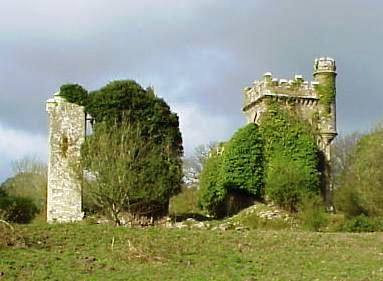
Brittas Castle – or what’s left of it – now called Brittas House, is being rebuilt, as indicated by this sign and as shown in the 2008 photo below.


This photo provided by Kevin Akers (click to enlarge photos)


Source for this photo


I found myself wondering: Who were the last Brittas Dunnes to own the estate? How did the end of Dunne ownership of the Brittas estate come about?

I found answers to these questions; I will start by setting the stage with the following information from an 1897 book. Allow me to introduce...


Major-General Francis Plunkett Dunne

"On the 18th April, 1853, Mr. W. E. Gladstone, who was Chancellor of the Exchequer in the Coalition Government...announced, when introducing the budget, that he would extend the income tax to Ireland. The poverty of the country
[for this was after years of famine], the full measure in which it already contributed to imperial revenue, and the necessity, on grounds of public policy, of offering some inducements to absentee landlords to reside at home, had hitherto prevented its extension.

Knowledge after the event, which is everyone's, has made it clear that Ireland was face to face with a crisis fraught with disastrous consequences to her material well-being. It may be asked, how did her people demean themselves? And who amongst them made timely and opportune protest? Into the breach created by Mr. Gladstone stepped Major-General Francis Plunkett Dunne.

The gage of battle cast down [something, such as a glove or other pledge thrown down as a challenge to combat, similar to "throwing down the gauntlet"] by the wizard of finance [Gladstone] he [Dunne] instantly took up.
Resistance to and protest against the financial injustice done to his country he made the great purpose of his life.

Upheld by his well-founded belief in the justice of his cause...he led for years a forlorn hope against the injustice and inconvincibility of England...[and was] unsuccessful in his objects and unappreciated in his actions, [although] time has more than amply vindicated both. If ever there be a Pantheon of distinguished Irishmen, his shall be no obscure corner therein. His name shall ever be indissolubly associated with the Irish protest against the over-taxation imposed by Mr. Gladstone [emphasis added].

On his father's side he traced his descent in unbroken line from the ancient Irish chieftains of Brittas, whilst his mother was sister to the first Earl of Bantry. Born in 1802, he graduated in Trinity College, Dublin, and entered the army as cornet in the Dragoon Guards. Retiring from the army in 1840, he entered Parliament, and represented Portarlington from 1847 to 1857, and the Queen's County from 1859 to 1868. A Conservative, he held office as Private Secretary to Lord Eglinton when Lord Lieutenant of Ireland in 1858-59.

He died on 6th July, 1874, and an obituary newspaper notice states that no man in the Queen's County was more generally or deservedly popular. In private life he was all that was estimable — courteous, honourable, and upright, a perfect gentleman, beloved by the poor as well as by the rich, and a thorough Irishman and lover of his country. All those who held intercourse with him during his long and honourable career were well aware of his sterling honesty and worth." (Source


♦♦♦

Brittas House

“During the Jacobite Wars in 1691, the only battle fought was in Tinnahinch. Eight hundred soldiers from King James' army were sent in May to capture Mountmellick, which was under the control of William of Orange. The Jacobean soldiers set up base at Brittas, as the Dunnes of Brittas were supporters of King James.

Destroyed by a fire in 1942, Brittas House was a fine castellated house, built in 1869 by General Francis Plunkett Dunne to the design of architect John McCurdy and stands near the ancestral home of the O'Dunnes. The gate piers of the grand house still remain on the western edge of The Green. The walls and windows give an idea of the house's architecture. It was three storeys (sic) high and the roof was thatched. On the wall over the main entrance, the family crest is still visible, it shows an eagle and a drawn sword. The last of the family to reside in Brittas House were two old ladies, daughters of Francis Plunkett Dunne [2nd].

The house had extensive gardens, shrubberies and out-offices. The links with Clonaslee village, and the remains of the Brittas Estate are strong. The expansive demesne grounds contain many splendid trees – remnants of the larger plantations. Lawson's cypress, copper beech, yew, sycamore, cut-leaved beech, and oak that covered much of the townland of Brittas over a century ago. Brittas Lake – which has recently been restored – was originally constructed as a reservoir for the house. Its banks are stone lined and water was pumped from the Clodiagh River. It is now a public amenity area.”
Source

What became of the Brittas Estate – and the Dunnes of Brittas?

Because having that info would be a fitting conclusion to the story of the Dunnes of Brittas, I began asking some questions. Below are excerpts from an exchange of messages containing data that Kevin Akers provided about this subject. (Kevin Akers is a GG grandson of Bridget Dunne of the Dunnes of Brittas. Jim Kennedy is a friend of his in Ireland - in the area of Brittas - who helps Kevin with local family history info.)

The fire at Brittas Castle

Kevin asked Mr. Kennedy about the 1942 fire that destroyed Brittas Castle, specifically about who was living there at the time. Here’s his response:

“Brittas House was empty, a caretaker lived nearby. Local lore has it that the fire was arson, started by [the] same caretaker because he was stealing the valuables inside and selling them off. The women, Alice Maud and Kathleen, [see below] both lived in England at that time. The story goes that one of them decided to move back to Brittas, so the caretaker set fire to the house, it burned for two days - a tragedy, really, as I can only imagine what this place would be like if it [had] survived.

Most large estate houses in Ireland are now exclusive hotels or golf resorts. Check out Kinnitty castle online, its only 15 minutes away. Some, like Birr Castle (a 30 minute drive from here), are still in the families - check both out on internet.”


The last of the Dunnes of Brittas

We have conflicting information about this, but it appears that the last of the Dunnes of Brittas was Kathleen Plunkett Dunne, daughter of Francis Plunkett Dunne 2nd – and that she was the one to dispose of the estate. Here are portions of the messages that lead me to that conclusion.

Message sent to Kevin Akers by Pat Dunn

“Thanks for forwarding Jim Kennedy's messages regarding Brittas. However, I still find myself confused. From the same source (JK) we have two versions of the story. One says the estate was sold to the Irish government by Alice and Arthur Cottingham, so it appears Alice was the last Dunne to own the estate.

Excerpt from the first of Jim Kennedy’s messages

‘Gen[eral] Dunne's nephew [Francis Plunkett Dunne 2nd] was [the] last male [Dunne to own the estate]. He died very young, leaving a wife and two infant girls, she remarried and the girls left Ireland. One returned with [a] new husband to live at Brittas and farm their large estate. Landlordism was at its end and so was English rule here. Alice and Arthur Cottingham [presumably the couple referred to above] sold the estate to the Irish government around 1924 and returned to the UK.’

From that info it appears that General Dunne’s grand nephew’s widow had a daughter, apparently named Alice Cottingham, who was the final family member to own Brittas – and she sold it in 1924.”

♦♦♦

In the second version, it doesn't specify by whom, but says the estate had been divided and sold to local farmers. Since the name ‘Alice’ is in both, perhaps she was, indeed, the last family member to own Brittas. A possible scenario is that after she and her husband sold it to the Irish government, the government sold it off in pieces to the local farmers. However, it's not clear from the info provided that's a correct analysis.

Excerpts from the two of Jim Kennedy’s other messages

“In 1850 Francis Plunkett Dunne was living in Brittas. When he died in 1874, his brother Edward Meadows [Dunne] got the estate, however he died the following year and his son, Francis Plunkett [Dunne] 2nd, inherited.

He died young in 1878, leaving two young daughters, Alice Maud and Kathleen. Kathleen
[the last member of the Dunnes of Brittas] died in England in 1958. She never married, so when she died that was the end of the Brittas line. By then the Estate at Brittas was no more, long since divided up and sold off to the local farmers. That’s it in brief.”


♦♦♦

Excerpt from response from Kevin Akers to Pat Dunn

“Independently from Jim, I found these two girls names in 1899 Burke’s Peerage: Francis Plunkett Dunne [FPD] of Brittas married his cousin Frances Jane, daughter of Rev. Robert Hedges Dunne, Rector if Lemanaghan in the King’s County. Frances Plunket died young [but she and FPD had two daughters], Alice Maud and Kathleen Plunket…

Jim Kennedy said it was Kathleen who sold off the estate - and I think that syncs up with what I found on ancestry.com.”


♦♦♦

So, there you have it. If my understanding is correct:

■ The males in the direct line of inheritors of Brittas gradually died off, with Francis Plunkett Dunne 2nd being the last male in the line;

■ The estate passed to his daughters, was later divided and sold off (or that may have occurred in the reverse order);

■ The last surviving daughter, Kathleen, died in 1958;

■ What’s now called Brittas House is undergoing a gradual rebuilding as the current owner has funds available.

Not incidentally, a branch of the extended family of the Brittas Dunnes emigrated to the United States, California in particular, and became major landowners and prominent citizens there. That’s a story for another day.

I’d like to visit Brittas House one of these days; with a little perseverance I may make it.

Last updated 8/2/2010

4/23/10

Life in Brittas, Family Seat of Ancient Dunn(e)s

Life in Brittas was reportedly very grand according to the daughter of Bridget Dunne, who was born and raised there.

Undated photo of Lucy Lawler Rogers, daughter of Bridget Dunne (click to enlarge it)

Kevin Akers, GG grandson of Bridget Dunne, is a descendant of the Dunnes of Brittas. Brittas was the family seat of the ancient Dunnes in County Laois in the province of Leinster in the Republic of Ireland.

He contacted me after reading about the Dunnes of Brittas in this blog, and sent me some family letters that say Bridget’s father was Peter Dunne of Brittas. In one of the letters, Bridget’s daughter, Lucy Lawler Rogers, describes life in the Brittas estate, where Bridget was born.

“Bridget Dunne, my mother, was the daughter of Peter Dunne of Balanclory(?), Brittas is Gaelic pronunciation. The name of the estates mean Stradbally and her mother was Miss MacDowall of the above [previously referenced] family. She never forgot her noble ancestry but was very proud, mild and deeply religious.

They were surrounded with beauty and wealth and servants. Mother, Bridget Dunne, was born there in that home and reared in refinement and education. Her very manner all thru life never changed, even thru the rude environment of family life of the 1850’s and 60’s on a mountain farm.

I only realize now all she bore in patience and silence thru her great piety and faith in God. She was educated in a convent by the Presentation sisters at Stradbally and had a very wonderful education, was particularly interested in astronomy and history.”

Source: Lucy Lawler Rogers in a letter written in the mid-1930s to her niece, Henrietta Welch, letter and photo provided by Kevin Akers
Last updated: 4/23/2010

4/6/10

Historical Info About Ancient Dunns

Ireland has a long and interesting history - and the ancient Dunn(e)s were aggressively involved in it.

◄ Brittas Castle (Source)


That history dates back centuries, during which Ireland suffered multiple invasions by outsiders. A major element of Ireland's history includes the fact that over several centuries Britain imposed its will upon the Irish in bloody and painful ways. Until starting the process of assembling our family's history, I'm embarrassed to report that I was completely ignorant about how the Irish had been treated during that era.

What I've learned has been astounding - and makes me sad when I think about how extremely evil it was.
Before getting into specifics about our ancient family's role in Ireland in that era, I will set the stage by briefly describing the conditions in Ireland in a portion of the time during which they lived.

♦♦♦

The Cromwell invasion

“Parliamentary forces had already landed in Ireland in 1647. But it was the arrival on August 15, 1649, of twenty thousand troops under Oliver Cromwell, Lord Lieutenant general of the Parliament of England that inaugurated a full scale repression of Ireland. His purpose was unambiguous: to avenge the alleged massacre of 1641, repress Catholicism, and fortify Ireland against possible foreign invasion. He believed his mission to ‘carry on the great work against the barbarous Irish’ was ordered by God.

It was this mindset that justified the brutality that followed. In one instance, when the town of Drogheda refused to surrender to Cromwell in September 1649, Cromwell’s soldiers stormed the city and put more than three thousand people, including civilian women and children, to the sword. Some weeks later, the town of Wexford did surrender, but apparently not fast enough to suit Cromwell, and his soldiers slaughtered two thousand civilians.

This campaign of terror had its desired effect, as most towns quickly surrendered to Cromwell’s forces. By the early 1650s, virtually all of Ireland had been conquered.

The toll on human life was extraordinary, even by modern standards. Of Ireland’s 1641 population of 1,448,000, 616,000 had died by 1652. Of those, the great majority (504,000) were native Irish, mostly Catholic…Thousands of surviving Irish rebels were transported to a life of slavery in the West Indies… ‘I am persuaded,’ wrote Cromwell, ‘that this is a righteous judgement of God upon these barbarous wretches.’ “

Cromwell's Legacy

"In addition to the death and destruction visited by Cromwell and his lieu­tenants, Ireland under parliamentary rule experi­enced another massive transfer of property from the Catholic native Irish to Protestant English settlers. Under the 1652 to 1653 Acts of Settlement, most of Ireland's major Catholic landowners in the east were forced to surrender their property (upon penalty of death) and accept lesser holdings in the remote barren reaches of the province of Connacht.

This policy, dubbed 'To Hell or Connacht' by the Irish, led to a mass ex­odus of Irish Catholics to the lesser lands in the west of Ireland. Many never made it. Some eleven million acres of confiscated land was turned over to English ‘adventurers’ (settlers) and soldiers. By 1660, Protestants would own 78 percent of the land in Ireland and the percentage was rising [reaching 90%, according to another report]." Source: 1001 things Everyone Should Know About Irish American History, by Edward T. O’Donnell


♦♦♦

“The Protestant English colonizers saw them [the Irish] as savage, shiftless, and primitive. They wanted an Ireland to resemble a civilized England. The hatred brewed between the English and Irish until the English concluded that the Irish were ‘wild,’ or ‘savage,’ and that ‘it was ‘no more a sin to kill an Irishman than a dog or any other brute.’ "

A blogger I've come across has written the following: "There are 80 million people of Irish descent living across the globe, on all the continents, largely as the result of having been forced out of their own country by the British genocidal ethnic cleansing, land theft, and brutal and barbaric laws which turned Ireland into nothing more than a slave colony for the benefit of England." Source


Another source says:

"…Henry Cromwell [Oliver's son]…said in the 1650s [that] the Irish needed to become more English - even if it took being sold into slavery to accomplish that." Source

Another site says, "...The Scots, the Irish, even British whites were sold into slavery in America..." and includes an illustration from the American publication, Harper's Magazine, showing recently freed slaves, both black and white. Presumably it was published after the emancipation of slaves in the U.S. after the U.S. Civil War in the 1860s. (Source)


[Editor's note: Do an Internet search for “Irish slaves” to learn about the amazing story of Irish slavery - which even includes Irish being kidnapped off the streets to be sold as slaves by the British. ]

♦♦♦

British control led to long-running, bloody conflicts between Britain and certain factions in Ireland over Ireland's desire for independence. Most Irish Catholics desired complete independence from Britain, but Irish Protestants feared living in a country ruled by a Catholic majority. (Source)

Britain wanted Ireland to remain under British dominion; in addition, British anti-Catholic discrimination led to many battles between the factions. 700 years of conflict ultimately led to what became the primarily Catholic Republic of Ireland - now independent - and primarily Protestant Northern Ireland - which remains part of Britain's United Kingdom.

Even after the partitioning of Ireland into two entities, tensions continued to brew between Catholics and Protestants, and came to be known as "The Troubles". It's beyond the scope of this blog to delve into that subject, but The Troubles have been a heavy dark cloud hanging over Ireland's people for decades.

♦♦♦


Irish Family Names

This is another area needing some background before I discuss family history. In my research I've learned that the form and spelling of Irish names has evolved / varied over the centuries. Following is some information about that topic, which will help as we explore our roots, for there have been many variations of our family name recorded in the annals of history. The Irish Times has a site showing that in the "Primary Valuation property survey of 1847 - 64" the following variants of the surname Dunn appear: Doyne, Dun, Dunn, Dunne. Recorded variants not listed in the valuation: Ó Duinn, Donne, Duínn, O'Doyne (Source)

Why such wide variation?

"In ancient Ireland the population was much smaller...and the mass movement of people was uncommon. It was usual therefore for a person to be known only by one name: Niall, Eoin, Art, etc. [If] there was no one else in the locality with the same name...this was not a problem. The Gaelic Clann system was well established and this gave people a common identity with the people of their tribe and with the commonly shared area.

This single name system began to break down during the eleventh century as the population was growing and there was a need for a further means of identification. The solution was to adopt a prefix such as Mac (Mc is an abbreviation) or Ó. Mac means 'son of' whilst Ó means 'grandson of'. Mac surnames are generally of a much later date than Ó. The vast majority of Gaelic Irish surnames were created during the eleventh and twelfth centuries.

[Ó comes from Ui, and since it was Ancient Irish for 'grandson of', an example of its use is that descendants of King Brian Boru were known as the 'Ui Brien' clan - and later the O'Brien clan.]

Septs: The Clans eventually broke up into a number of distinct septs or groups. These groups were headed by an original member of the clan and dominated a particular part of the countryside. It was not uncommon for septs from the same clan to be found in completely different parts of the country...


The sept system was an integral part of Gaelic society and survived and was even propagated by the Norman invaders. The system did not survive the English invasion and colonisation of the seventeenth century however, and it became a disadvantage to have a Gaelic sounding name.

Anglicization: The Penal Laws that were enforced by the [British] colonists attempted to completely subjugate the Gaelic way of life. It is about this time then, that many Gaelic names changed to their Anglo equivalent or translation. This can cause confusion, as many of the names were misinterpreted or misspelled..." (Source)


Another factor regarding the recording of names is the lack of literacy in those days. Those who recorded the entries spelled names the way they sounded, and the bearers of the names, who often couldn't read, didn't know whether or not the names were recorded correctly.

♦♦♦

Another item about names: I’ve wondered why some Irish names use the “O” as a prefix while others do not. What determined whether the family name was Dunne instead O’Dunne, for example? Then I found information that provides clues to the answer.

Based upon the quote below, it appears that both the “O” and the “Mac” were dropped by some Irish families, perhaps in the process of anglicizing their names to avoid the persecution associated with their Gaelic / Irish names. However, in the case of the Dunnes, it was reportedly mandated by the terms of what was called their “letter of patent” or "patent" for short, which was the grant by which they received title to their estate.

“The respectability derived from the renown of the [heroic] Irish officers abroad [discussed previously in this item] induced some of their relatives at home to resume the Os and Macs. Some have been prevented from so doing by the patents of their estates, as Kelly, of Castlekelly, in the county of Galway, and Dunne, of Iregan, in the Queen's County, who are ordered by distinct clauses to reject the O', and not to take any form of name indicating clanship of any kind. Other Irish families, however, who were not bound by patents of this kind, have resumed their ancient names."
Source

Ancient Dunn(e)s Fought Against the English

As I've looked for documentation of our family's history I've found a number of references to our ancient forbears, several of which are cited below. My research shows that the ancient Dunn(e)s were frequently involved as warriors in the disputes with Britain.

From a website called Irish Midlands Ancestry:


"O'Heerin, [historian and poet] who died in 1420, thus refers to this district, in his topographical poem: 'Over the Hy-Regan of the heavy onslaughts, A vigorous band who rout in battle, Rules O'Dunne, chief of demolition, Hero of the golden battle-spears."


♦♦♦


In this blog we see place names that are confusing, at least to me. This quote from the Annals of the Kingdom of Ireland helps a bit, for it explains the Hy-Regan reference above (including its various spellings) and why it's used in connection with our ancient family:

"Hy-Regan was the tribe name of the O'Dunnes of Offaly. Their country, which was formed into the barony of Tinahinch, and made a part of the Queen's County [Laois] in the reign of Philip and Mary, is still popularly called Dooregan, (in Irish tuath Riagain)." (Source)


Here's a quote from an ancient text that also helps us understand the place names below, for it illustrates the fact that territories were labeled with various names over time:

"1448 - Ui-Riagain, now anglicised Oregan, Iregan, and Dooregan. This territory still locally retains its ancient name, and is co-extensive with the barony of Tinnahinch, in the northwest of the Queen's County. The present representative of O'Duinn, of this territory, is Colonel Francis Duinne, MP. For his pedigree, see Annals of the Four Masters A.D. 1448, p. 968 and 1585, p. 1840." Source

♦♦♦

Okay, with all that background out of the way we can now dig into our family's history.
From The Book of Irish Families, Great & Small:

"O'Duinn, O'Doinn, (O)Dunne, O'Doyne, Dun, Dunn


The Chiefs of the O'Dunne family in Ireland were known as Lords of Ui Regan in
Co[unty] Leix (Queens County) where the family originates. They were centered in the
barony of Tinnahinch, in Leix, [now spelled Laois] with Brittas as a major stronghold. The [O'Dunne] name has also been found in the kingdom of Meath as a chief in the district of Tara...

In earlier times O'Doyne was a common way to spell the name. In 1659 Dunn was found as a principal name in Dublin and in Kildare and Kings Counties, while McDunn was found as a principal name of Fermanagh. Dun was also also a principal name in Kings [now Offaly] and Queens [now Laois] counties at that time.

The noted O'Heerin speaks of the O'Dunne family thusly: 'Over Ui Riagain of the mighty victories are active warriors who conquer in battle; O'Dunn is the chief of the conquering troops, the mainstay of the battling spears... This line is traced back to 1427.' "


The Ancient Dunn(e)'s Family Seat Was Called "Brittas"

"A king (or lord) ruled large areas of land. To protect his land from invasion, the king gave parts of it to local lords, who were called vassals. In return, his vassals promised to fight to defend the king's land." (Source)


"A 'seat' or 'family seat' was the principal manor of a medieval lord, which was normally an elegant country mansion and usually denoted that the family held political and economic influence in the area. The term continues to be used in the British Isles today." (Source)


◄ This photo and the one above are of the castle that was once the family seat of our ancient Dunn forebears. This photograph, taken in 2006, is the front entrance of what remains of Brittas Castle in the village of Clonaslee, County Laois, Republic of Ireland.

Click
source for a larger view of this photo; other views of Brittas Castle are below.
About the Clonaslee Area

"Although a number of archaeological finds in the area indicate the presence of settlements in the area from the Neolithic period, the modern day Clonaslee has evolved from its beginnings as an Anglo-Norman town of the late-12th century. At this time the eskers and related landforms gave a great strategic advantage by providing ideal vantage points where mottes and other defensive battlements were constructed. This advantage also had a profound influence on the location of towns and villages throughout the county.

From the 12th to 17th centuries, recorded history does not provide much detail on the development of Clonaslee. The most significant period in the village's growth undoubtedly took place from the 16th century under the influence of the Dunnes of Brittas.

This family left [its] mark on the form and history of the village as evidenced in its planned form and also from a number of ruins in the area. The former residence of a young branch of the family remains in ruins one mile from the village at Clara Hill. Also, near the east bank of the Clodiagh River stand the ruins of Ballinakill Castle, built in 1680 by Colonel Dunne.

Throughout the 18th century, Clonaslee prospered due to its location on an important highway across Laois leading onto Munster. The proximity of Brittas - the seat of the Dunnes - was also influential, as the power of this family had by now grown beyond that of a native Irish Chieftain.
In 1771, Francis Dunne, then head of the Dunne Family...built a thatched parish chapel in the village. This was located close to the site of the present church. The Dunne family continued to finance the construction of landmark buildings in the village. The parish church was erected in 1814 under General Dunne..." Source

♦♦♦

From Landed Estates Database:

"(Estate) Dunne - The ancient family of O'Doinn or Dunne were confirmed in their possession of the manor of Brittas in county Laois in the 17th century. By the time of Griffith's Valuation [published between 1847 and 1864] the Dunnes owned land in the parish of Fuerty, barony of Athlone, county Roscommon and in the 1870s are recorded as owning 1,544 acres in the county and 9,215 acres in Queen's County (county Laois)."

Other Historical References to the Family
From an 1899 book called A genealogical and heraldic history of the landed gentry of Ireland:


■ "The estate of Brittas has been since time immemorial in the ancient family of Dunne, anciently O'Doinn, chief of the name, and a sept of historic note..." [See the bottom of this page for a definition of a sept.]

■ This is an ancient Irish sept, whose chieftains formerly ruled over Hy-Regain, a territory comprised in the present Queens Co[unty]. They were the same race as O'Conor Failghe, O'More, and O'Dempsey, and Irish genealogists derived their descent from Cathair Mor, Monarch of Ireland.


Brian Oge Dunn, of Brittas, b[orn] 1599. He obtained from [King] Charles I, a patent for a large estate in the barony of Tinnehinch to hold to him and his heirs forever in soccage, provided he did not take the name, style or title of O'Doinn, and that he should drop that name and call himself Brian Dunn."


♦♦♦


From a website called Digital Irish Genealogy Data comes this:
"County Laois in Ireland, variously spelled Leix and Laoighis, was - for awhile - named Queen's County. Laois [pronounced 'leash'] was the Irish name for the region. It was dominated in the north by the O'Dempsey and O'Dunn clans, and in the south the O'More or O'Moore clan...

The 25 Most Common Names in Laois:

Dunne
Delany
FitzPatrick
Whelan
Kelly
Brennan
Lalor
Conroy
Moore
Byrne
Phelan
Bergin
Carroll
McEvoy
Murphy
Walsh
Brophy
Ryan
Kavanagh
Maher
Doolan
Dowling
Dooley
Connor
Gorman


♦♦♦

Another website has this to offer:

"In its form "Dunn" [it] is an English surname, from the Old English dunn, "dark-coloured", and some of the surname in Ireland are undoubtedly of English descent. However, the vast majority of those bearing the name in Ireland descend from the
Ó Doinn, from donn, used to describe someone who was swarthy or brown-haired.

The Ó Doinn first came to prominence as lords of the area around Tinnehinch in the north of the modern Co. Laois (formerly Queen’s Co.), and were known as Lords of Iregan up to the seventeenth century. They were especially active in the resistance to the plantations of King’s and Queen’s counties in the sixteenth century. At that time the surname was generally anglicised as "O'Doyne".

Today the name is still extremely common in that part of Ireland, though it is now also widespread throughout the country, with particular concentrations in Leinster. Perhaps because of the stronger English influence, in Ulster the name is generally spelt "Dunn", while it is almost invariably "Dunne" in other parts."
Source

♦♦♦

Yet another site provides the following:
"The surname Dunn comes from the Gaelic word 'donn' which means 'brown'. Its Gaelic form O'Duinn, 'the descendants of Donn' is most commonly anglicized as Dunn, but is also written as Dunne.

The Dunn family is of the same Celtic stock as the O'Connors and O'Dempseys, clans who trace their descent from Rossa Failgeach, eldest son of Cathaoir Mor, King of Ireland in the second century. The Dunn sept stems from Riagan, tenth in lineal descent from Failgeach. The district ruled over by Riagan, located in County Leix (present-day Laois), became the ancestral home of the Dunns. In later times their chieftains were known as Lords of Iregan.

The Dunns were in the forefront of every battle for Irish nationalism. They suffered heavily in the bitter and prolonged struggle against Cromwell. In the next generation they espoused the Stuart cause, and the head of the family was killed in the battle of Aughrim. With the fall of the Stuarts, the lands of the Dunns were confiscated, and their fighting men who survived followed Sarsfield and the 'Wild Geese' to fight in the ranks of the Irish Brigade in France. Many of them served with distinction in the regiments of O'Donnell, Lord Clare, and Walshe up to the days of the French Revolution.

Following the Norman invasion of Ireland in the 12th century, one of the prominent Norman families, the Fitzgeralds, settled in the south of Ireland. Over the following centuries, the Fitzgeralds became ardent supporters of Irish independence and were often allied with the Dunns in the subsequent campaigns."
Source

The Geography


◄ Here’s a map of Great Britain, which includes England, Scotland, Wales and Northern Ireland. [Click to enlarge]


◄ This map shows the four provinces of Ireland. Ulster, in Northern Ireland, is still part of the British empire while the other three provinces make up the Republic of Ireland. Leinster, in the east of Ireland, is made up of the counties of Carlow, Dublin, Kildare, Kilkenny, Laois, Longford, Louth, Meath, Offaly, Westmeath, Wexford and Wicklow. [Click to enlarge]


◄ This map provides a look at County Laois in relationship to the other counties in the province of Leinster. It is situated in what is called the Irish Midlands and shares a border with five other counties; Offaly to the northwest, Tipperary to the southwest (see previous map), Kilkenny to the south, Carlow to the southeast and Kildare to the east. [Click to enlarge]


◄ This map of Laois shows the area called Clonaslee in the northwest “corner”. This area was the homeland of the ancient forebears of the Dunns; the history of the area is discussed later.
[Click to enlarge]


O Doinns / O'Duinns / (O)Dunn(e)s / (O)Doyne(s) Were Chieftains / Lords in Ancient Ireland

“The O'Duinn (Dunne) sept were Lords of Úí Riacáin (Iregan, Hy-Regan, or Oregan), naming their territory after their ancestor Riacáin. Riacáin was a son of the Úí Failge over-king Cináed, and a grandson of Mugrón, another Úí Failge king who was slain beside Kildare monastery in 782. By the 11th century the O'Duinn territory was centered in the barony of Tinnahich, the most northern barony of Co Leix (Laois, Queens County).”
Source

♦♦♦

“Seosamh compiled “Historical Notes on Laois and Place Names of Ballyroan” which was published by the Old Laois Society. He then went on to write Duthai Ui Riagain, a history of Ui Riagain territory and a genealogy of its chieftains - the O’Dunnes.”
Source

♦♦♦

“The O'Dunnes - an ancient and formidable tribe

The O'Dunnes originated as a sept in the present County Laois and formed one of the principal families of Leinster, their chiefs being Lords of Iregan in that county. The sept is one of these specially mentioned in the mid-sixteenth century official orders as hostile and dangerous to the English interest.”
Source

♦♦♦

Clonaslee and the Ancient O'Dunnes


“The ancient O'Dunne territory is now represented by the Barony of Tinnahinch and includes the parishes of Clonaslee and Rosenallis. In his history of Queen's County (Laois), Canon O'Hanlon writes - 'The family of Dunne of Brittas is of extreme antiquity. From time immemorial the sept has been settled in Hy Regan and the tribal lands still at the turn of the century remain in the possession of the family, curtailed, indeed, by forfeitures and confiscations commencing with [King] James I's scheme for the plantation of the King's and Queen's Counties'."
♦♦♦

Dunn(e)s Descend from Irish Royalty

From: Lagin Pedigrees from the O'Clery Book of Genealogies / MacMurrough - Kings of Leinster

"Cahir Mor: This monarch was king of Leinster in the beginning of the second century. He divided his great possessions amongst his thirty sons in a will called "the Will of Cahirmore", contained in the "Book of Leacan" and in the "Book of Ballymote."

His posterity formed the principal families in Leinster: namely, the O'Conors "Faley," princes of Offaley; the O'Dempseys, the O'Dunns, the O'Regans, MacColgans, O'Hartys, MacMurroughs, kings of Leinster; the Cavenaghs, O'Byrnes, O'Tooles, O'Murphys, O'Mulrians, or O'Ryans, the O'Kinnsellaghs, O'Duffys, O'Dowlings, O'Cormacs, O'Muldoons, O'Gormans, O'Mullens, O'Mooneys, etc.

The other chief families of Leinster, of the Heremon line, descended from the same stock as the ancestors of Cahir Mor, were the MacGillpatricks or Fitzpatricks, princes of Ossory; the O'Dwyers, chiefs in Tipperary; the O'Nolans, chiefs in Carlow; the O'Brennans, chiefs in Kilkenny, etc.

[Editor's note: We have ancestral family lines in each of the families highlighted above in red, meaning that we are - in four ways - distant descendants of Cahir/Cathair Mor. Of him it's reported, "The 'provincial kingdom' of Leinster...was re-founded circa 175/185...by Cathair 'Mor', who is [also] reckoned the first King of Laigin [Leinster] or the first king of a new era of the history of the kingdom."] (Source)


♦♦♦

Regarding the O'Dunnes: “One of the septs of Offaly descended from Ros Failghe, son of Cathair Mor, King of Ireland, and their early history is hid in the mists of the past; but State and other papers show them to have been a powerful tribe whose raids and forays caused anxiety to the English Pale, which they frequently harried with fire and sword, returning to their fastnesses laden with spoil… Their territory, though isolated, covered with thick forest, and bounded on the south, like a wall, by the Sieve Bloom mountains, was early an object of desire to the Norman invaders. In early times the name was anglicised O'Doyne.”


"In the early 1500's, the O'Dunnes were a powerful tribe and they ruled over a large area known as Hy-Regan. They frequently raided and harassed the English Pale and then retreated to the mountains." (Source)

♦♦♦

O Dunn or Dunne - Originally O Doyne - Lords of Iregan / Irish - Ui Doinn or Ui DuinnDonn…. A Sept - Family branch of the Hy Regan with their territory in Dooregan - Tuath Riagain anglicized to the Barony of Tinahinch - Tinne Hinch. It was in the north of the kingdom of Leix - Co[unty] Laois in mid-western Leinster where they were Kings & Chiefs. They were cleared out of Cloneagh in Co[unty] Laois twice by the English who were transplanting English Planters there to extend The English Pale around Dublin. Also Kings & Chiefs in Co[unty] Meath in north-east of Leinster and Chiefs in County Kildare in Central Leinster. (Source)

 
◄ This map shows where “The Pale” [the dark green area] was in relation to the area where the ancient O’Dunnes were located. They were ideally located to attack the English Pale and then withdraw back to their territory.


The English Pale

"In Irish history, the fortified area round Dublin, where English rule operated after the English settlement of Ireland in 1171. The term soon came to include the surrounding counties of Dublin, Meath, Kildare, and Louth, and was recognized politically until the early 17th century, when medieval boundaries were overtaken by the Plantation of Ireland 1556–1660.The phrase ‘beyond the Pale’ derives from the English Pale. The English settlers living inside the Pale in Ireland considered themselves to be cultured and law-abiding, while the Gaelic Irish living outside the Pale were viewed as uncivilized and lawless. Hence when someone behaves in a manner that is beyond the bounds of acceptability they are said to be ‘beyond the Pale’.
The phrase reflects the culturally negative view of the Irish held by many of the British over the centuries. Further evidence of negativity is seen in the Statute of Kilkenny passed by the English parliament held in Kilkenny in 1366. The statute attempted to ban intermarriage and contact between Anglo-Norman settlers and the Irish. Although this restriction was as much to do with fear of the Irish people and loss of property through marriage and other contracts, it also reflects the Anglo-Norman colonists' culturally negative view of Gaelic society." (Source)


The Ancient Dunn Family Built Several Castles “The O’Dunn clan, originally known as Dunn Ui Riagain, controlled the northern territory of the Sieve Blooms [mountains in County Laois] for most of the last millennium. Ruins of the O’Dunn castles are still evident at Castlebrack, Tinnahinch, Castlecuffe and Brittas. The village of Clonaslee was the nucleus of the clan and many O’Dunn chieftains are buried there.” Source

♦♦♦About Brittas Castle"When the main residence in Tinnahinch was blown up in 1653, the Dunne Chief had to build anew. At this time there was a low thatched lodge located at Brittas, near the present village of Clonaslee. The Dunnes built a mansion at right angles to this, facing north-east. Concurrently, they heightened the thatched building to accommodate the servants.

Major-General Francis Plunkett Dunne built a neo-gothic mansion at Brittas in 1869, to a design by John McCurdy. It was extended ten years later by Millar and Symes. It is believed that General Dunne obtained loans from Germany to build the castle, and rental income from his tenants was used to repay the lenders.

Brittas Castle went on fire on Thursday, June 25, 1942, and despite the best efforts of the Tullamore Fire Brigade, it was destroyed."
Source


◄ The ruins of Brittas Castle


◄ Sketch of the castle


◄ Another view


◄ And another


◄ The castle from the north


◄ And from the west


◄ Brittas Castle's tower


♦♦♦

Brittas Castle Today
Following the creation of this blog I was contacted by Kevin Akers, whose GG grandmother was Bridget Dunne - who was born at Brittas. In one of the messages Kevin sent me he said the following:

"I have been in touch with an Irishman who is doing research on General Dunne of Brittas. He had this to say about the current state of the Castle:

Brittas house is there, just about, but little survived the fire and its subsequent owners. It's a long story.


Gen[eral] Dunne's heir did not marry, so a grand nephew was last male Dunne[to own the estate]. He died very young, leaving a wife and two infant girls, she remarried and the girls left Ireland. One returned with [a] new husband to live at Brittas and farm their large estate.

Landlordism was at its end and so was English rule here. Alice and Arthur Cottingham [presumably the couple referred to above] sold the estate to the Irish government around 1924 and returned to the UK.

The house itself and a few acres remained until that fire in 1942. A local man bought the ruined house and proceeded to ruin it some more. Nothing remained but the Tower and one Gable end. Then about six years ago a young man bought it and is now rebuilding the house.

At this moment, that construction has halted due to our economic woes, but [the current owner] tells me he will finish Brittas.The village here, Clonaslee, was essentially built by Gen[eral] Dunne around 1810. There is a web site, Clonaslee.net." (Source: email message received 23 August, 2010)

The Family's Impact on the Area
“The most significant period in the village's growth undoubtedly took place from the 16th century under the influence of the Dunnes of Brittas.

This family left [its] mark on the form and history of the village as evidenced in its planned form and also from a number of ruins in the area. The former residence of a young branch of the family remains in ruins one mile from the village at Clara Hill. Also, near the east bank of the Clodiagh River stand the ruins of Ballinakill Castle, built in 1680 by Colonel Dunne.

Throughout the 18th century, Clonaslee prospered due to its location on an important highway across Laois leading onto Munster. The proximity of Brittas
- the seat of the Dunnes - was also influential, as the power of this family had by now grown beyond that of a native Irish Chieftain.

In 1771, Francis Dunne, then head of the Dunne family...and built a thatched parish chapel in the village. This was located close to the site of the present church.”
Source

♦♦♦“Local attractions include Brittas Lake, Brittas Castle (which is currently being renovated by a private owner), and a range of walking routes with some beautiful scenery to suit all levels of fitness.”
Source

♦♦♦“Clonaslee means meadow of the way. It was in this village at the foot of the Slieve Bloom Mountains, close to the great highland from Tara to Cashel, the story of Blooms began.”
Source

♦♦♦

Irish Students Write About History of Clonaslee, With Info About Ancient Dunn(e)s
“Laois: History of Clonaslee revealed through students' publication

Friday, 09 May 2003
The finishing touches are being put to a historical publication by the transition year students of Clonaslee Vocational School. The publication, entitled "A Historical Study of the Clonaslee Area", will feature research carried out by the students since September.

Research involved collecting photographs, newspaper articles, pamphlets and books, as well as interviewing local people and attending a local history talk. The study begins with the first settlers in the area around 3000 BC and covers different historical ages up to 1900, including information on the local graveyards, hedge schools and the 1798 rebellion in Clonaslee.”
Source

♦♦♦Following are links to the study referred to in the article above. It’s very interesting, not only because of the background it provides on the area itself, but also because the Dunnes/O'Dunnes are referred to in almost every section below.

“Historical Study of Clonaslee Area”
Preface
Pre-History Times
Early Christian Monasteries
The Norman Times
The Plantations and Jacobite Wars
Fortified Houses
The O' Dunnes of Hy-Regan
Rosenallis and William Edmundson
The Penal Laws
The 1798 Rebellion
Agriculture around 1800
The Poor Law System and the Famine
The Land Wars 1879 - 1882
The Village of Clonaslee
Bibliography
Map of Clonaslee Area

♦♦♦


More Interesting History


I received, in a message from an Irish genealogy email group, a link to a small book that's online at this site. Some readers of this blog may find the book to be of interest because it includes discussion of the geographical area our ancient family was in (they're recorded as "O'Duins", "Duinnes", "O'Duinues" and "Dunnes" in this book). Here's a passage from the book, discussing a scene reached after ascending a mountain in the area.

"The view is awesome, not only for rare beauty, but across the bogland solitude lies the history of Ireland. There are scars on the land, earthen outlines of raths, the residences of prehistoric kings, ruined abbeys and fortresses, relics of hundreds of years of warfare as the O'Regans, O'Mores, O'Carrols, O'Dempseys, O'Duins and others of the Ui Failge tribes united to expel the intruders, first the Vikings, then the Danes, and finally the English.

Frequently the boglands were soaked with blood - but it is still the land of the invincible, the unconquerable Irish. There is an eerie equality about these mountains. Perhaps restless spirits still hover over the land."


Trivia: Another interesting excerpt from the book illustrates the family connection between the O'Regans and the ancient Dunn(e)s: "Gathering all the able bodied men of the O'Regan clan, and their close relatives, the Duinnes of Castle Bollinkill, the O'Regans engaged the enemy at the pass of the great Bog of Allen..."

Bollinkill - actually Ballinakill - in County Laois is a seventeenth-century market town. The ruins of Ballinakill Castle are of a late seventeenth-century castle built by the Dunnes (but never inhabited) on the site of one destroyed by Cromwellian troops under Fairfax. The configuration of streets around the large rectangular square is eighteenth-century.The town's entrance from Abbeyleix is marked by two trees known as toll Trees where a toll was paid by visitors to the town. The town had important fairs, a brewery, woollen and tanning factories.] (Source)

The book shows that Ronald Reagan's ancestral line was the O'Regans - and he was a distant descendant of Cathaor/Cathir Mor, High King of Ireland. Both the Nolans and Dunn(e)s are too, which means we are very distant relatives of President Reagan.
Definition of Terms

Some of the terms in the material above need definitions, at least for me, so I've included them here:


Clan: Kinship group based on actual or purported descent from a common ancestor, as traced through the male (patriclan) or the female (matriclan) line. Clans are normally exogamous, marriage within the clan being regarded as incest. Clans may segment into subclans or lineages, and genealogical records and myths may be altered to incorporate new members who lack kinship ties with the clan. Clan membership may be useful in ensuring mutual support and defense as well as in the mediation of disputes over property rights and the mode of residence after marriage. Some clans express their unity by means of a common emblem. See also exogamy and endogamy

Sept: A sept is an English word for a division of a family, especially a division of a clan. The word might have its origin from Latin septum "enclosure, fold", or it can be an alteration of sect.

The term is found in both
Ireland and Scotland. It is sometimes used to translate the word slíocht, meaning seed, indicating the descendants of a person (i.e., Slíocht Brian Mac Diarmada, the descendants of Brian MacDermott).

Historically, the term 'sept' was not used in Ireland until the nineteenth century, long after any notion of clanship had been eradicated. The English word 'sept' is most accurate referring to a sub-group within a large clan; especially when that group has taken up residence outside of their clan's original territory. (
O'Neill, MacSweeney, and O'Connor are examples.)

Related Irish septs and clans often belong to larger groups, sometimes called tribes, such as the
Dál gCais, Uí Néill, Uí Fiachrach, and Uí Maine. Recently, the late Edward MacLysaght suggested the English word 'sept' be used in place of the word 'clan' with regards to the historical social structure in Ireland, so as to differentiate it from the centralized Scottish clan system.

This would imply that Ireland possessed no formalised clan system, which is not wholly accurate.
Brehon Law, the ancient legal system of Ireland, clearly defined the clan system in pre-Norman Ireland, which collapsed after the Tudor Conquest. The Gaels, when speaking of themselves, employed their term 'clan'.

Tribe: A unit of sociopolitical organization consisting of a number of families, clans, or other groups who share a common ancestry and culture and among whom leadership is typically neither formalized nor permanent.

Last updated 5/5/20