4/2/10

Origin and History of the Surname Grace

Michael Dunn and Bridget Grace are each recorded as being born in Ireland around 1830-35, were married in the village of Glossop in County Derbyshire, England, in 1853, emigrated to the U.S. in 1858 and became the great grandparents of WIlliam Edward (Bill) Dunn. Their stories are covered elsewhere in this blog and the following is a "snapshot" of the origin and history of the surname Grace.

"This interesting name has two possible origins, both dating from the early medieval period in England. The first is from a nickname, from the Middle English and Old French word "grace", charm, pleasantness, from the Latin "gratia". The second origin is from the female given name "Grace", which was popular during the Middle Ages, and is thought to derive in the first instance from the Old German "grisja", Old French "gris", grey, which is found in Middle English as "grece, greyce". However, the name was soon associated with the adjective "grace" as used in the nickname for a charming, pleasant person.

The personal name is first recorded in England in Suffolk in 1188, as "Grecie", and is listed as "Gracia" in 1213 (Surrey). The surname development includes Gilbert Gracye (1296, Sussex) and Adam Grace (1302, Suffolk). One George Grace was an early emigrant to the American colonies, leaving London on the "Globe" in August 1635, bound for Virginia. The first recorded spelling of the family name is shown to be that of Henry Grece, which was dated 1275, in the "Northamtonshire Hundred Rolls", during the reign of King Edward 1, known as "The Hammer of the Scots", 1272 - 1307.

Surnames became necessary when governments introduced personal taxation. In England this was known as Poll Tax. Throughout the centuries, surnames in every country have continued to 'develop' often leading to astonishing variants of the original spelling." Source

♦♦♦


Another source said, “I have found up to 20 different possible origins for the surname GRACE. The majority of GRACEs in the world today, of Irish origin (Kilkenny), are associated with (direct descendants or tenant farmers of the lands of) Norman lord William le Gros.”


♦♦♦

Yet another source said, "This surname is certainly derived from the French word gros, meaning large. McLysaght’s heart ruled his head when he derived the Irish Graces from the famous Raymond le Gros, one of the first invaders of Ireland in the 1160s. In fact they descend from William le Gras of Chipping Sodbury in Gloucestershire, several of whose sons came to Leinster in the train of William Marshall I in the early thirteenth century and obtained lands in Kilkenny, Carlow and Laois from him. William was a Norman aristocrat with a pedigree traceable back to eleventh century France. Today the name is principally found in Kilkenny and Dublin. Source

Last updated 4/2/2010

3/29/10

The History of Surnames and Coats of Arms


Surname Origin and History

This cartoon is silly, but it leads us into the subject of how we obtained our names, which I find interesting.
These days we generally take having first, middle and last names for granted. However, it wasn't always this way. In times past, people in most cultures went by just one name, their "given" name. Over time, that began to change. For example, during Biblical times people were often referred to by their given names and the locality in which they resided, such as "Jesus of Nazareth" and "Saul of Tarsas". However, as populations grew, the need to identify individuals by surnames became necessary.

European surnames first emerged between the eleventh and fifteenth centuries. Prior to this, particularly during the "Dark Ages" between the fifth and eleventh centuries, people were largely illiterate, lived in rural areas or small villages, didn’t travel very far, and had little need of distinction beyond their given names, or what we today call “first” names - or more formally, "forenames".

♦♦♦

The development of surnames has been affected by many factors, including social class, social structure, cultural tradition, and naming practices in neighboring cultures. The majority of surnames are derived from patronymics, i.e. the forming of a surname from the father's given name such as Johnson, meaning literally "the son of John." In some rare cases, the naming practice was matronymic, where the surname was derived from the mother's given name.


In Ireland a male's surname generally takes the form Ó/Ua (originally "grandson") or Mac ("son") followed by the genitive case of a name, as in Ó Dónaill ("grandson of Dónall") or Mac Gearailt ("son of Gerald"). In other words, the tradition was to use the prefix "Mac" to indicate that the bearer of that name was the "son of" someone and the prefix "O" to indicate that the bearer was a grandson. Thus, O'Reilly was the grandson of Reilly and MacDonald was the son of Donald. An interesting article about Irish names can be found here.

English Surnames Generally Fall Into Four Broad Categories

■ Those derived from personal names: Richards, Jones [Jon being a variation of John], Johnson, Robinson, Thomas, Martin, Williams, Matthews, Jackson, etc.

■ Those derived from place names or geographic features: Essex, Kent, York, Telford, Stokes, Carlisle, London, Marston, Lancaster, Charlton, Dover, Wood, Hill, Bush, Green, Field, Moore, Moss, Marsh, Waters, Lake, Hedges, Banks, Burn, Hall, Towns, etc.

■ Those derived from occupations: Butcher, Baker, Smith, Mason, Shepherd, Farmer, Cooper, Hooper, Fletcher, Thatcher, Taylor, Wright, Skinner, Carpenter, Joiner, Weaver, Cook, Miller, etc.

■ Those derived from nicknames or physical descriptions: Grey, Black, White, Green, King, Lord, Baron, Earl, Noble, Bishop, Bold, Strong, Armstrong, Quick, Young, Long/Lang, Short, Broad, etc.

Similar naming methods occurred in other languages. Some immigrants retained the original spelling when they arrived on our U.S. shores, but some anglicized their names to better fit into their new society. For example, one of our ancestral lines is Schwarz, which means Black in German. Our ancestors in this line retained the original spelling, but others changed their names to Black after they arrived here.

This diversified approach to naming people has led to a rich, interesting tapestry of surnames in this country - and around the world.

♦♦♦

Surname spelling and pronunciation have evolved over centuries, with current generations often unaware of the origin and evolution of our surnames. Among the humbler classes of European society, and especially among the illiterate, individuals had little choice but to accept the mistakes of officials, clerks, and priests who officially bestowed upon them new versions of their surnames.

In North America, the linguistic problems confronting immigration officials at Ellis Island in the 19th century were legendary as a prolific source of Anglicization. In the United States such processes of official and accidental change caused Bauch to become Baugh, Micsza to become McShea, Siminowicz to become Simmons, etc. Many immigrants deliberately Anglicized or changed their surnames upon arrival in the New World, so that Mlynar became Miller, Zimmerman became Carpenter, and, as discussed above, Schwarz might become Black.

Hence, regardless of the current spelling of our surnames, the spelling and pronunciation have evolved over the centuries. In some cases, the current generation may be aware of the change. A schoolmate of mine in the 1950s whose name was Sylvestrovich had become Silvers when I encountered him in the 1970s. His children and other family no doubt know of the change. However, in many cases a change of surname occurred so long ago that we are not aware of the original spelling and pronunciation.

The origin and history of surnames can be very interesting, particularly to the bearer of that surname.

Heraldry and Coats of Arms

Heraldry emerged in western Europe in the 12th century to meet the necessity for military identification. It was originally developed by the military aristocracy as a hereditary system of identification using visual symbols.

The term is commonly accepted as pertaining to the devising, granting, and use of Coats of Arms, or armorial bearings. This type of symbolism became so popular that it was soon adopted by civilian individuals and by corporate bodies such as town governments, universities, and the church, and eventually by regiments and national states.

A Coat of Arms was originally a light tunic (i.e. a surcoat extending down to the knees) decorated with symbols and worn over battle armor. The symbolism served to identify the wearer (whose face might be covered by the visor of his helmet) as the member of a particular family or group. The symbology itself eventually became known as a Coat of Arms.

This article is adapted from this source and this source.
Last updated 4/2/2010
3/24/10

Origin and History of the Surname Dunn

Michael Dunn and Bridget Grace are each recorded as being born in Ireland around 1830-35, were married in the village of Glossop in County Derbyshire, England, in 1853, emigrated to the U.S. in 1858 and became the great grandparents of WIlliam Edward (Bill) Dunn. Their stories are covered elsewhere in this blog and the following is a "snapshot" of the origin and history of the surname Dunn.

“This interesting surname, found in England, Scotland and Ireland, has a number of possible origins. Firstly, it may be of Anglo-Saxon origin, from the Olde English pre 7th Century and Middle English 'dunn', meaning 'dull, brown, dark-coloured', and was a nickname for a man with dark hair or a swarthy complexion. It may also have originated from an unrecorded Middle English survival of an Olde English byname, 'Dunna', dark.

Secondly, the surname is widespread in Ireland, where it is the Anglicized form of the Gaelic 'O'Duinn, Doinn', composed of the Gaelic prefix 'O', male descendant of, and the personal name 'Duinn, oinn', from 'donn', black, brown, a byname given to someone with dark hair or swarthy complexion, as above.

In Ireland the name is usually spelt 'Dunne', and the sept [similar to a clan] originated in County Leix and formed one of the principal families of Leinster where their chief was the Lord of Iregan; they were especially mentioned in mid 16th Century documents as hostile and dangerous to the English interest. Those who spelt their name Dunn usually came from Ulster, where they were possibly of Scottish extraction. Finally, in Scotland, the surname also derives from this Celtic origin, but may also be locational from the lands of Dun, Tayside (Angus), which derives from 'dun', fort.

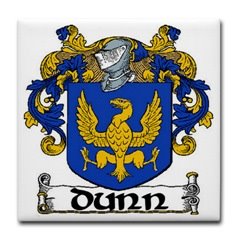
Early recordings include William Dun (1180, Gloucestershire), John le Dun (1198, Hertfordshire), and Adam de Dun (1255, Scotland). A Coat of Arms granted to a Dunn Family in Bircher, near Leominster, depicts quarterly first and second silver, a gold wolf salient, second and third, black three round gold buckles, tongues downward. The first recorded spelling of the family name is shown to be that of Gillananaomh O'Duinn, which was dated 1102, in the 'Ancient Irish Records', during the reign of Irish High Kings in Opposition, 1103 - 1169.

Surnames became necessary when governments introduced personal taxation. In England this was known as Poll Tax. Throughout the centuries, surnames in every country have continued to 'develop', often leading to astonishing variants of the original spelling.”

Last revised 3/23/2010
Source

3/23/10

Origin and History of the Surname Schwarz

William Edward Dunn (1861-1908) married Josephine Barbara Lauer. Her parents, Casper and Emma Schwarz Lauer, emigrated from Germany to the United States in 1853 and became the great grandparents of WIlliam Edward (Bill) Dunn (1918-1986). Their stories are covered elsewhere in this blog, and below is a "snapshot" of the origin and history of the Schwarz surname.

"Recorded in many forms, this surname of early German and Dutch origins, is one of great popularity, particularly in the USA. In 1965 it was calculated to be the 10th most popular surname in New York City. Like many names of pre-medieval origins, it is a form of descriptive nickname.

It derives from the pre 8th century word 'swarz' meaning 'black' and as such was given to a person of dark or swarthy appearance. The Angles and Saxons were fair, and this suggests that the 'swarz' as applied to people may have been nationalistic, and given to the Gauls, however this is conjecture.

What is certain is that there are many spelling forms. The usual spellings today are Schwartz and Schwarz, but Schwarte, Schwartzer, Schwarzer, and Schwar(t)zmann, are also well recorded. The name is also popular in The Netherlands with the additional spellings of (de) Swart, Swarte, or de Zwart, in Poland as Szware, and in Czechoslovakia as Svarc. It also acted as the prefix to other names to create compounds such as Schwartzkopf and Schwarzchild as examples. These surnames are 'ornamental' with no literal meaning.

Examples of early German recordings include Werner Swartz, which was dated 1316 at Worms, Thiman Swarte of Greifswald in the year 1350 a.d., and Wicboldus dictus Swarte of Barth, in the year 1356. Later examples are those of Anne Ursula Schwarz of Pfalz, christened there on October 16th 1618, whilst the name is very early into America, Abagail Swartz, (of Dutch origin) being christened at Albany, New York, on September 16th 1687.

Throughout the centuries, surnames in every country have continued to 'develop', often leading to astonishing variants of the original spelling."

Last revised 3/23/2010
Source

Origin and History of the Surname Lauer


William Edward Dunn (1861-1908) married Josephine Barbara Lauer. Her parents, Casper and Emma Schwarz Lauer, emigrated from Germany to the United States in 1853 and became the great grandparents of WIlliam Edward (Bill) Dunn (1918-1986). Their stories are covered elsewhere in this blog, and below is a "snapshot" of the origin and history of the Lauer surname.

"This surname was a German unflattering nickname for a crafty or cunning person, and was originally derived from the Old German word LURE. It was also occasionally used as an occupational name for a tanner, and a German habitational name from LAUER in Franconia, named from the stream on which it stands.

It was also a French topographic name for someone who lived by a conspicuous laurel tree. The name was originally rendered in medieval documents in the Latin form LAURUS. The name was borne by various minor saints, including a hermit, a martyr and an abbot.

The name is also spelt LAURE, LAURE, LAURO, LAURIER and LAURAS. The earliest French hereditary surnames are found in the 12th century, at more or less the same time as they arose in England, but they are by no means common before the 13th century, and it was not until the 15th century that they stabilized to any great extent; before then a surname might be handed down for two or three generations, but then abandoned in favour of another.

In the south, many French surnames have come in from Italy over the centuries, and in Northern France, Germanic influence can often be detected. The first hereditary surnames on German soil are found in the second half of the 12th century, slightly later than in England and France. However, it was not until the 16th century that they became stabilized.

The practice of adopting hereditary surnames began in the southern areas of Germany, and gradually spread northwards during the Middle Ages.

A notable member of this name was Max von LAUE, (l879 - l960) German physicist, born near Koblenz. He was professor at Zurich, Frankfurt and Berlin. He did good work in relativity, predicted that X-rays would be diffracted by a crystal, and won the Nobel prize for physics in l9l4. He was later appointed director of the Kaiser Wilhelm Institute for Theoretical Physics (l95l)."

Last updated 3/23/2010
Source