skip to main |
skip to sidebar

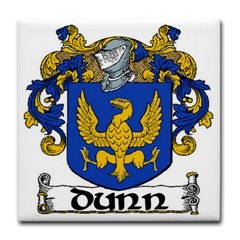
Michael Dunn and Bridget Grace are each recorded as being born in Ireland around 1830-35, were married in the village of Glossop in County Derbyshire, England, in 1853, emigrated to the U.S. in 1858 and became the great grandparents of WIlliam Edward (Bill) Dunn. Their stories are covered elsewhere in this blog and the following is a "snapshot" of the origin and history of the surname Dunn.“This interesting surname, found in England, Scotland and Ireland, has a number of possible origins. Firstly, it may be of Anglo-Saxon origin, from the Olde English pre 7th Century and Middle English 'dunn', meaning 'dull, brown, dark-coloured', and was a nickname for a man with dark hair or a swarthy complexion. It may also have originated from an unrecorded Middle English survival of an Olde English byname, 'Dunna', dark.Secondly, the surname is widespread in Ireland, where it is the Anglicized form of the Gaelic 'O'Duinn, Doinn', composed of the Gaelic prefix 'O', male descendant of, and the personal name 'Duinn, oinn', from 'donn', black, brown, a byname given to someone with dark hair or swarthy complexion, as above.In Ireland the name is usually spelt 'Dunne', and the sept [similar to a clan] originated in County Leix and formed one of the principal families of Leinster where their chief was the Lord of Iregan; they were especially mentioned in mid 16th Century documents as hostile and dangerous to the English interest. Those who spelt their name Dunn usually came from Ulster, where they were possibly of Scottish extraction. Finally, in Scotland, the surname also derives from this Celtic origin, but may also be locational from the lands of Dun, Tayside (Angus), which derives from 'dun', fort.Early recordings include William Dun (1180, Gloucestershire), John le Dun (1198, Hertfordshire), and Adam de Dun (1255, Scotland). A Coat of Arms granted to a Dunn Family in Bircher, near Leominster, depicts quarterly first and second silver, a gold wolf salient, second and third, black three round gold buckles, tongues downward. The first recorded spelling of the family name is shown to be that of Gillananaomh O'Duinn, which was dated 1102, in the 'Ancient Irish Records', during the reign of Irish High Kings in Opposition, 1103 - 1169.Surnames became necessary when governments introduced personal taxation. In England this was known as Poll Tax. Throughout the centuries, surnames in every country have continued to 'develop', often leading to astonishing variants of the original spelling.”
Last revised 3/23/2010Source

William Edward Dunn (1861-1908) married Josephine Barbara Lauer. Her parents, Casper and Emma Schwarz Lauer, emigrated from Germany to the United States in 1853 and became the great grandparents of WIlliam Edward (Bill) Dunn (1918-1986). Their stories are covered elsewhere in this blog, and below is a "snapshot" of the origin and history of the Schwarz surname. "Recorded in many forms, this surname of early German and Dutch origins, is one of great popularity, particularly in the USA. In 1965 it was calculated to be the 10th most popular surname in New York City. Like many names of pre-medieval origins, it is a form of descriptive nickname.
It derives from the pre 8th century word 'swarz' meaning 'black' and as such was given to a person of dark or swarthy appearance. The Angles and Saxons were fair, and this suggests that the 'swarz' as applied to people may have been nationalistic, and given to the Gauls, however this is conjecture.
What is certain is that there are many spelling forms. The usual spellings today are Schwartz and Schwarz, but Schwarte, Schwartzer, Schwarzer, and Schwar(t)zmann, are also well recorded. The name is also popular in The Netherlands with the additional spellings of (de) Swart, Swarte, or de Zwart, in Poland as Szware, and in Czechoslovakia as Svarc. It also acted as the prefix to other names to create compounds such as Schwartzkopf and Schwarzchild as examples. These surnames are 'ornamental' with no literal meaning.
Examples of early German recordings include Werner Swartz, which was dated 1316 at Worms, Thiman Swarte of Greifswald in the year 1350 a.d., and Wicboldus dictus Swarte of Barth, in the year 1356. Later examples are those of Anne Ursula Schwarz of Pfalz, christened there on October 16th 1618, whilst the name is very early into America, Abagail Swartz, (of Dutch origin) being christened at Albany, New York, on September 16th 1687.
Throughout the centuries, surnames in every country have continued to 'develop', often leading to astonishing variants of the original spelling."
Last revised 3/23/2010
Source

William Edward Dunn (1861-1908) married Josephine Barbara Lauer. Her parents, Casper and Emma Schwarz Lauer, emigrated from Germany to the United States in 1853 and became the great grandparents of WIlliam Edward (Bill) Dunn (1918-1986). Their stories are covered elsewhere in this blog, and below is a "snapshot" of the origin and history of the Lauer surname. "This surname was a German unflattering nickname for a crafty or cunning person, and was originally derived from the Old German word LURE. It was also occasionally used as an occupational name for a tanner, and a German habitational name from LAUER in Franconia, named from the stream on which it stands.
It was also a French topographic name for someone who lived by a conspicuous laurel tree. The name was originally rendered in medieval documents in the Latin form LAURUS. The name was borne by various minor saints, including a hermit, a martyr and an abbot.
The name is also spelt LAURE, LAURE, LAURO, LAURIER and LAURAS. The earliest French hereditary surnames are found in the 12th century, at more or less the same time as they arose in England, but they are by no means common before the 13th century, and it was not until the 15th century that they stabilized to any great extent; before then a surname might be handed down for two or three generations, but then abandoned in favour of another.
In the south, many French surnames have come in from Italy over the centuries, and in Northern France, Germanic influence can often be detected. The first hereditary surnames on German soil are found in the second half of the 12th century, slightly later than in England and France. However, it was not until the 16th century that they became stabilized.
The practice of adopting hereditary surnames began in the southern areas of Germany, and gradually spread northwards during the Middle Ages.
A notable member of this name was Max von LAUE, (l879 - l960) German physicist, born near Koblenz. He was professor at Zurich, Frankfurt and Berlin. He did good work in relativity, predicted that X-rays would be diffracted by a crystal, and won the Nobel prize for physics in l9l4. He was later appointed director of the Kaiser Wilhelm Institute for Theoretical Physics (l95l)."
Last updated 3/23/2010
Source

Edward Francis Nolan's - aka Francis Edward Nolan - and Mary Ring Nolan's parents each emigrated from Ireland to the United States in the mid-1850s. Mary and Ed, as he was known, were the parents of Hazel Nolan Dunn - the mother of WIlliam Edward (Bill) Dunn.
Ed and Mary's stories are covered elsewhere in this blog. Following is a brief "snapshot" of the origin and history of the Nolan surname.
“This famous Irish surname is recorded in the varied spellings of O'Nolan, O'Noulane, O'Noland, O' Nowlan, and the short forms of Nolan, Nowlan, and Nowland. However spelt today it is an anglicized form of the original pre 12th century Gaelic O'Nullain, which translates loosely as 'The descendant of the crier', probably a reference to the first chief of the clan who held the hereditary office of herald to the Kings of Leinster. The chief was known as the Prince of Foherta, and he held the barony of Foherta, the modern barony of Forth.
A branch of the family migrated to Connacht in the 16th Century and gained possession of extensive land tracts in Counties Galway and Mayo. A smaller branch settled in Corca Laoidh (South-West Cork) and here the name appeared as O'Huallachain meaning 'proud' or 'noble'.
The nameholders seem to have lost most of their holdings after the Battle of the Boyne in 1690 when they supported James 11nd, (1689 - 1690), the last king of Ireland. The name later gained prominence in the British Army. Captain Lewis Nolan (1818 - 1854), was the foremost exponent of Light Cavalry tactics, and it was he who carried the famous order for the charge of the Light Brigade. Owing to a misunderstanding between Nolan and Lord Lucan, the charge resulted in the total destruction of the Brigade, and the death of Nolan himself.
The first recorded spelling of the family name is shown to be that of Teag O' Nuallain, which was dated 1672, in Lynch's register known as 'De Praesulibus'. This was during the reign of King Charles 11nd of England, known as 'The Merry Monarch', 1660 - 1685. Surnames became necessary when governments introduced personal taxation. In England this was known as Poll Tax. Throughout the centuries, surnames in every country have continued to 'develop', often leading to astonishing variants of the original spelling.”
Last revised 3/23/2010
Source

Mary E. Ring was the first wife of Edward Francis Nolan, aka Francis Edward Nolan. She was the mother of Hazel Nolan Dunn, and died during or shortly after giving birth to Hazel, who was the mother of William Edward (Bill) Dunn. Mary's grandparents, John Ring and Mary Delaney Ring emigrated from Ireland to the United States in the mid-1850s, and what we know about them is covered elsewhere in this blog. Following is a brief "snapshot" of the origin and history of Mary's surname.
"This interesting name, with variant spellings Ringe and Rings, derives from the Old English pre 7th Century 'hring' meaning ring. The Old High German word "hring" and the Old Norse 'hringr' have the same meaning, and conesquently, the surname may also be either German or Scandinavian in origin.
It is generally accepted that Ring was originally given as a metonymic occupational name to a maker or rings, to be worn either as jewellery or as component part of chain-mail, but latterly, in Scandinavia it was adopted as an ornamental name.
The surname was first recorded in England at the beginning of the 13th Century, (see below). On July 10th 1598 Anna Ringe and Robitus Crifte were married in St. Martin-in-the-Fields, Westminster, London, and on November 14th 1624,
John Ring, an infant, was Christened in Dulwich College, Dulwich, London. John Ring, (1572-1821), a surgeon of renown, rendered most important services to the cause of vaccination.
The first recorded spelling of the family name is shown to be that of Eilwinus Ring, which was dated 1207 - The Chartulary Rolls of Norfolk, during the reign of king John, Nicknamed "Lackland", 1199 -1216.
Surnames became necessary when governments introduced personal taxation. In England this was known as Poll Tax. Through-out the centuries, surnames in every country have continued to "develop", often leading to astonishing variants of the original spelling."
Last revised 3/23/2010
Source