4/21/09

The Dunn Name and Interesting Trivia


Background

Dunn is of Irish and Scottish origin. In Gaelic [old Irish] Dun means a heap, hill, mount[ain]; a fortress, a castle, fastness, a tower. The saxon version, Dunn, means brown, of a dark color, swarthy.

♦♦♦

Name Variations and History

In Irish, Ó Duinn or Ó Doinn (doinn is the genitive case of the adjective donn - brown) is more often written Dunne than Dunn in English. The form O'Doyne, common in the seventeenth century, is now almost obsolete. In fact of 364 births registered for them in a given year, 313 had the final E and only 51 were Dunn. From this it can be estimated that the total number of people so called in Ireland today is approximately 15,000, giving them twenty-seventh place in the list of most common surnames in Ireland.


The Dunn name is first found in County Meath in Ireland where they held a family seat from very ancient times. A “seat” or “family seat” was the principal manor of a medieval lord, which was normally an elegant country mansion and usually denoted that the family held political and economic influence in the area. The term continues to be used in the British Isles today.
Shown above is a drawing of Brittas castle (discussed below), stronghold of our ancient ancestral family. Click on it to enarge it.

Some of the Many Variations of the surname Dunn:


Doyne [with alternative spellings of Doyen and Doying in one family from which I've received emails. I was also sent the following info by a man named Al Doyne: "I've also been in contact with a guy who grew up in Ireland, now in this country, who speaks Gaelic. according to him the original name O'Duinn [see below] in Gaelic is pronounced O'Doyne! O'Doyne being the Anglicized spelling."]
Dun
Dunn
Dunne
Ó Duinn
Doine
Done
Donne
Doyon
Duínn
Ó Duinn
Ó Doinn
O'Dienne
O'Doyne
O'Dunne
O'Dunn

Primary
source

♦♦♦

Trivia: A Disney Connection

Those of us raised with Donald Duck and Mickey Mouse should enjoy knowing that we are related (at least in a distant way) to Walt Disney. Consider the following.

About 1824-5, Major Laurence Esmond Dunne, born in 1782, son of Laurence Dunne of Ards, married Sophia Disney, daughter of one James Disney. They had a son, Arthur Disney Dunne, Barrister-at-law, in 1826. His
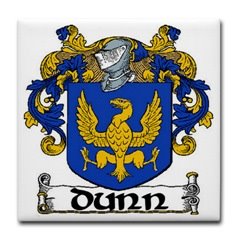
coat of arms shows the connection, for on it is included the name "Arthur Disney Dunne". (The “e” on the end is just one of many variations of the spelling of the ancient Dunn name.)

A researcher on a website I ran across reported that the Disney family had some genealogy work done by the “General Office”, and the Deputy Chief Herald of Ireland reported that the Dunnes/Dunns are distantly related to the Disney family - 23rd cousins, he reports.


♦♦♦

Trivia: Sept vs. Clan


"Sept" is a term from Irish culture in the nineteenth century used to explain the use of a variety of surnames by members of a single clan. Where Scots would say "MacGregor and his clan" an Irish historian might say "O'Neill and his sept". The English word 'sept' is most accurate when referring to a sub-group within a large clan - especially when that group has taken up residence outside of their clan's original territory.

The Dunne sept originated in County Leix (Queen's County) and formed one of the principal families of Leinster, their chief being lords of iregan in that county. The sept is one of those specially mentioned in the mid sixteenth century official orders as hostile and dangerous to the English interest. It is in that part of the country that Dunnes are, appropriately, now to be found in greatest numbers, though they have spread far and wide.


♦♦♦

Geographic Origin of the Spelling "Dunn"

The island of Ireland is divided into four historic regions: Ulster, Connaught, Leinster and Munster. Each region contains multiple counties. The counties of Donegal, Monaghan and Cavan in Ulster belong to the Republic of Ireland. The remainder of Ulster belongs to the UK and is known as Northern Ireland. Here's a link to a map that shows the relationship of Ulster to the rest of Ireland.

The significance of the above paragraph is that nearly all those who spell the name Dunn came from Ulster. This is a name to which the practice of resuming the discarded prefixes Mac and O does not apply - the form O'Dunn or O'Dunne is seldom if ever seen today.


♦♦♦

Trivia: Selected Famous Irishmen

At least one [person] of the name is to be found in the gallery of famous Irishmen, viz., Gillananaomh O Duinn (1102-1160), the historian and poet. One was killed at the battle of Aughrim in 1391. Another very active Jacobite was James O'Dunne (circa 1700-1758). Bishop of Ossory, most of whose life was spent in France, in the service of which country several of his relatives distinguished themselves as
diplomatists and soldiers.

In modern times Charles Dunn (1799-1872), was a notable judge in the USA; and Col. Humphrey O'Dunne was famous for his bravery in the attack on Savannah in 1774.


The Irish-American author Finlay Peter Dunn, has been noticed in the article on Dooley (q.v.). Sir Patrick Dun (1642-1713), five times President of the Royal College of Physicians, Ireland, and Irish M.P., whose memory is perpetuated in Sir Patrick Dun's Hospital, Dublin, was of a Scottish family.

Source

♦♦♦


Trivia: U.S. Presidents of Irish and Scots-Irish Descent

Although not related to the Dunn name, an interesting bit of trivia I've found is that at least twenty-three of the fourty-four presidents of the United States have some Irish and/or Scots-Irish origins, although the extent of this varies. For example, both of Andrew Jackson's parents were Irish born, while George W. Bush has a rather distant Irish ancestry.

President John Kennedy had far stronger Irish origins, which fell much closer in terms of date. In addition, Ronald Reagan's father was of partial Irish Catholic ancestry, while his mother had some Scots-Irish ancestors. James K. Polk also had Scots-Irish ancestry. Within this group, only Kennedy was raised as a practicing Roman Catholic. President Barack Obama's Irish heritage originates from his mother, who was an Irish/English mix.

Here's a
link to the complete list of presidents with some Irish in their heritage.


♦♦♦

Trivia: We Are Descended from Ancient Irish Royalty


I subscribe to an online group called "clanndunne", and from it received the message below. It’s of interest because Dunne is one variation of the Dunn name, and we're all related if we go far enough up our ancestral line.

In the message, the reference to "Mullach Abu: [meaning] The Summit to Victory" comes from the family crest, and was a Gaelic battle cry used by Dunns/Dunnes in ancient days, i.e., when knights were fighting on horseback, etc.

♦♦♦


From: paddydunne29@hotmail.com
To: clandunne@yahoogroups.com

Subject: [clandunne] reunionDate: Fri, 04 Sep 2009

“Well hello to all my Dunne family. I am trying to get all the Dunnes I can together to have a reunion, hopefully in may 2010 in Co[unty] Loais, home to our greatest ancestors.

I need as many of you Dunnes as I can muster. I myself have about 60 family members who will come [brothers & sisters, aunts, uncles, and their children] so if you would like to help do this we need as many Dunnes as we can.

We are also trying to erect something in Brittas castle, where our forefathers came from. It was our stronghold - and to those who don’t know, we are descendants of Cathair Mor, High King of Ireland, so we are and were a very important family in Ireland.

So, let’s get the clan together. This is a once in a lifetime thing - something to tell the grandkids about - so please, I need a lot of help on this. Please email me and help get this started; email is paddydunne29@hotmail.com

Thanks; Mullach Abu: The Summit to Victory”


♦♦♦

This message about a reunion prompted me to do a bit of research on the subject of the "Cathair Mor, High King of Ireland". This
site provides info about Cathair Mor, and makes references to his descendants, including the "O'Dunnes" and the "O'Nolans", both lines being part of our ancient ancestral families.

Bottom line: The information on that site indicates that we are descendants of a king of ancient Ireland through both our Dunn and Nolan lines.

♦♦♦


Here’s another reference to the O'Dunne's being descended from a king of Ireland. From a
page titled, "The O'Dunnes -- an ancient and formidable tribe – Ancestral Research, Family History, Laois, Offaly, Genealogy" comes this:

"[The O'Dunne's are] One of the septs [similar to a clan] of Offaly descended from Ros Failghe, son of Cathair Mor, King of Ireland, and their early history is hid in the mists of the past; but State and other papers show them to have been a powerful tribe whose raids and forays caused anxiety to the English Pale, which they frequently harried with fire and sword, returning to their fastnesses laden with spoil…"


The English Pale

In the early 1500's, the O'Dunnes were a powerful tribe and ruled over a large area known as Hy-Regan. They frequently raided and harassed the English Pale and then retreated to the mountains.

The Pale, or the English Pale, was directly under the control of the English government in the late Middle Ages. Here’s a portion of the information I found about it.

“In the period immediately after the Norman Settlement was constructed the barrier, known as the "Pale," separating the lands occupied by the settlers from those remaining in the hands of the Irish. This barrier consisted of a ditch, raised some ten or twelve feet from the ground, with a hedge of thorn on the outer side. It was constructed, not so much to keep out the Irish, as to form an obstacle in their way in their raids on the cattle of the settlers, and thus give time for a rescue.”

The phrase "beyond the pale" dates back to the 14th century, when the part of Ireland that was under English rule was delineated by a boundary made of stakes or fences, and known as the English Pale. To travel outside of that boundary, beyond the pale, was to leave behind all the rules and institutions of English society, which the English modestly considered synonymous with civilization itself.


Last updated 6/15/2012

How Could They Afford the Passage?


◄
For the 150th anniversary of Ireland’s "Great Hunger" of the 1840s, the city of Philadelphia placed this Irish Memorial in a park.
(Click photo to enlarge / Source)


“The Irish Memorial, a national monument in Philadelphia, Pennsylvania, is dedicated to the memory of more than one million innocent men, women and children who perished during the years 1845 to 1850 and to the millions of Irish immigrants who found, here in the United States of America, the freedom, liberty and prosperity denied to their ancestors in Ireland.

The centerpiece of this project is a monumental bronze sculpture set in a 1.75 acre dedicated park. The artist who sculpted the memorial included 35 life-sized figures and the bronze work measures a spectacular 30 feet long by 12 feet wide and 12 feet high. The memorial depicts the cruel starvation which claimed one million Irish lives between 1845 [and] 1850; the harrowing journey to America taken by a million more; and the indomitable spirit of those who arrived safely and resolved to face the challenges of life in a new world.” (Source)

♦♦♦

The Cost of Emigrating to the U.S. in the Mid-1800s

In the process of assembling our family history I found myself reflecting at length upon the circumstances that would have driven our ancestral Irish families – Michael and Bridget Grace Dunn, Edward and Mary Ellen Kavanaugh Nolan and John and Mary Delaney Ring – to leave their homes and families in Ireland (via England in the case of M & B).

Think about it. Poor Irish immigrants spent as long as three months traveling in horrible conditions on what were described as “coffin ships” to come to what was then an untamed wilderness. The research I’ve done helps me understand that these were extraordinary people – and people I’d like to have known, for they had to have been enormously courageous and very resourceful.

I've also found myself wondering how much the passage would have cost. Michael and Bridget Dunn were married in the village of Glossop in County Derbyshire, England, before emigrating to the U.S., and I came across this exchange on a Derbyshire genealogy message board
. (GBP = Great Britain Pound, the symbol of which is £.)

A person posted this question:
“Having found 2 families going to America in 1857 & 1887, can anyone tell me how much it would have cost? In both instances the males went first, followed a few months later by their families.”


A man by the name of John responded: “In 1887 the fare UK-US was GBP 4 (steerage). Sorry, I don't have values for 1857.” He later added, “My GBP 4 was taken from Drew Keeling's ‘The effects of the 1904 North Atlantic fare ware upon migration between Europe and the United States’ and is cited as deriving from Cunard Voyage Accounts.”

Another person responded as follows: “I have the minutes of a Fressingfield Suffolk Parish meeting in 1837 stating that the cost of passage and provisions was 4 pounds 10 shillings. So…John's 4 GBP would be a reasonable assumption for 1857 if no other firm data is found. Put the sum in context: Williamson's 'Research in Economic History – The Structure of Pay in Britain' found that the average annual pay for an Agricultural Labourer was £30.03 in 1835, £29.04 in 1851, £36.04 in 1861, £41.05 in 1871 and £41.52 in 1881.”


So, if a person earned about £36 in 1858 – when Michael and Bridget emigrated – and the cost for passage was £4, that’s about 13% of a year’s income. For someone earning $30,000 today, for example, that equates to about $3,900 in today’s U.S. dollars (as a percentage of income). Quite a lot of money in the poverty-stricken days of the Irish potato famine – when people were literally dying of starvation.

Once I realized how expensive it was to emigrate, I had another question: How on earth could the starving Irish peasants who wanted to emigrate possibly come up with the money? I then learned that some of them may not have had to pay for it themselves. In fact, they may not have even had a choice. Consider:

Irish Emigration: Departure, Crossing and Arrival

Under the heading of “Coffin Ships” in an online essay about the Irish famine, I found the following.

“The worst ships were those which brought emigrants sent out by their landlords, and of all the sufferings endured during the famine, none aroused such savage resentment, or left behind such hatred, as the landlord emigrations.

Before the famine, responsible landlords, for instance, Lord Bessborough and Lord Monteagle, advanced money and paid the cost of passages for tenants to emigrate. Lord Monteagle, in particular, believed that in emigration lay the solution of Ireland's population problem, and the Monteagle Papers contain a number of letters from grateful emigrants; he was also responsible for setting up the Select Committee of the House of Lords on Colonization, that is, emigration, in 1847.

Another landlord, Mr. Spaight, of Limerick, a well-known ship broker, bought Deify Castle, in Tipperary, for £40,000 in 1844, and found 'a dead weight of paupers'. As he was engaged in the passenger trade, he offered free passage and provisions to those willing to emigrate, and the value of two pounds on landing, provided the tenants 'tumbled', that is, pulled down, their cabins.

He made the offer only to entire families, and said he had 'got rid of crime and distress for £3 10s. a head'. The first failure of the potato was followed by a number of landlord emigrations, and a total of more than a thousand tenants from various estates reached Quebec in 1846, those arriving early in the season being reasonably healthy and, on the whole, adequately provided for. [Because Canada was under English dominion and the U.S. was known to be anti-English at the time, many of the Irish who landed in Canada subsequently walked to the U.S. because of their own anti-English feelings.]

The fatal year 1847 brought a change. In January the Government announced that the whole destitute population was to be transferred to the Poor Law, to be maintained out of local [tax] rates at the expense of owners of property, and the only hope of solvency for landlords was to reduce the number of destitute on their estates.

Emigration began to be used as an alternative to eviction, and Sir Robert Gore Booth, a resident landlord, was accused by Mr. Perley, the Government emigration agent at St. John, New Brunswick, of 'exporting and shoveling out the helpless and infirm to the detriment of the colony'.

Sir Robert in reply put forward the landlord's point of view, declaring that emigration was the only humane method of putting properties in Ireland on a satisfactory footing. The country was overpopulated, and it was not right to evict and turn people out on the world. To emigrate them was the only solution.

Emigration also saved money; the cost of emigrating a pauper was generally about half the cost of maintaining him in the workhouse for one year, and once the ship had sailed the destitute were effectually got rid of, for they could return only with immense difficulty. In 1847, therefore, the temptation was strong to ship off as cheaply as possible those unfortunates who, through age, infirmity or the potato failure, had become useless and an apparently endless source of expense.” Source


♦♦♦

Some Irish Were Sold as Slaves

Beyond all that, there are the twin issues of slavery and indentured servitude that occurred during that period of Irish history. Posted on another page of this blog, but also relevant here, a blogger I've come across has written the following:

"There are 80 million people of Irish descent living across the globe, on all the continents, largely as the result of having been forced out of their own country by the British genocidal ethnic cleansing, land theft, and brutal and barbaric laws which turned Ireland into nothing more than a slave colony for the benefit of England."
Source

Another source says: “The Protestant English colonizers [in Ireland] saw them [the Irish] as savage, shiftless, and primitive. They wanted an Ireland to resemble a civilized England. The hatred brewed between the English and Irish until the English concluded that the Irish were 'wild,' or 'savage,' and that 'it was ‘no more a sin to kill an Irishman than a dog or any other brute.' "

"…
Henry Cromwell [Oliver's son]…said in the 1650s [that] the Irish needed to become more English - even if it took being sold into slavery to accomplish that." Source

Another site says, "...The Scots, the Irish, even British whites were sold into slavery in America..." and includes an illustration from the American publication, Harper's Magazine, showing recently freed slaves, both black and white. Presumably it was published after the emancipation of slaves in the U.S. after the U.S. Civil War in the 1860s. (Source)

[Editor's note: Do an Internet search for “Irish slaves” to learn about the amazing story of Irish slavery - which even includes Irish being kidnapped off the streets to be sold as slaves by the British. ]

♦♦♦

Indentured Servitude - Another Form of Slavery

Another site provides insight into what was called "indentured servitude".

“The arrogant disregard for the holocaust visited upon the poor and working class Whites of Britain [including the Irish] by the aristocracy continues in our time because the history of that epoch has been almost completely extirpated from our collective memory.

When White servitude is acknowledged as having existed in America, it is almost always termed as temporary 'indentured servitude' or part of the convict trade, which, after the Revolution of 1776, centered on Australia instead of America. The 'convicts' transported to America under the 1723 Waltham Act, perhaps numbered 100,000.

The indentured servants who served a tidy little period of 4 to 7 years polishing the master's silver and china and then taking their place in colonial high society, were a minuscule fraction of the great unsung hundreds of thousands of White slaves who were worked to death in this country from the early l7th century onward.

Up to one-half of all the arrivals in the American colonies were Whites slaves and they were America's first slaves. These Whites were slaves for life, long before Blacks ever were. This slavery was even hereditary. White children born to White slaves were enslaved too.

Whites were auctioned on the block with children sold and separated from their parents and wives sold and separated from their husbands. Free Black property owners strutted the streets of northern and southern American cities while White slaves were worked to death in the sugar mills of Barbados and Jamaica and the plantations of Virginia.

The Establishment has created the misnomer of 'indentured servitude' to explain away and minimize the fact of White slavery. But bound Whites in early America called themselves slaves. Nine-tenths of the White slavery in America was conducted without indentures of any kind but according to the so-called 'custom of the country,' as it was known, which was lifetime slavery administered by the White slave merchants themselves.

In George Sandys laws for Virginia, Whites were enslaved 'forever.' The service of Whites bound to Berkeley's Hundred was deemed 'perpetual.' These accounts have been policed out of the much touted 'standard reference works' such as Abbott Emerson Smith's laughable whitewash, Colonists in Bondage.

I challenge any researcher to study 17th century colonial America, sifting the documents, the jargon and the statutes on both sides of the Atlantic and one will discover that White slavery was a far more extensive operation than Black enslavement. It is when we come to the 18th century that one begins to encounter more 'servitude' on the basis of a contract of indenture. But even in that period there was kidnapping of Anglo-Saxons into slavery as well as convict slavery.”
(Source)

♦♦♦

So What's the Answer - How Could They Afford the Passage?

As I’ve read and researched Irish-American history, I’ve learned that the question of how impoverished Irish peasants were able to find a way to cross the Atlantic to the New World - whether during the potato famine or in other years - has several possible answers:

■ "When, in the eighteenth century, the death penalty came to be regarded as
too severe for certain capital offences [which were often minor crimes such as petty theft], transportation [of Irish convicts] to North America...became popular as a mitigation of such sentences." (Source)

■ Later, some Irish convicts were sentenced to penal colonies in Australia and places like New South Wales and Tasmania. Some of those people were political dissidents and some were "transported", as it was called, after having been found guilty of such heinous crimes as stealing a meal, petty theft, or stealing a sheep to feed a starving family. However, some of these convicts escaped and made their way to America.

"...One of the most spectacular Irish escapes from imprisonment in Australia is called the Catalpa Affair... The Catalpa, changing its course from a Florida landing to New York harbor, reached New York in August 1876. Tammany Hall hosted a reception for the escapees and the streets were cleaned for a parade in lower Manhattan. There was no ticker tape, but we can assume that some politicians were present..."

■ Some Irish were shipped to North America and elsewhere by the English Lords who reportedly owned as much as 90% of the land in Ireland, i.e., the landlords. They did so because it cost the Lords less for passage on a ship than the cost of the taxes levied on them to support workhouses for the the poor who lived on their estates;

■ Some were simply kidnapped, sold as slaves, and sent to America and elsewhere because it was lucrative for the slave merchants – and the Brits saw it as a way to reduce the number of "surplus poor" they had to contend with;

■ Some Irish sold themselves and traded several years of their lives to work as indentured servants in exchange for passage to the New World. They did this because they perceived life in bondage in the New World as being less onerous than the grim future they faced in Ireland;

■ In some cases, regardless of how the initial passage was financed, one member of a family emigrated first, worked, saved money, and sent it back to Ireland so others in the family could follow.

"Money from America: This was a well known epigram throughout Ireland. Often the money was used to develop chain emigration; money sent home for another family member to move to America... In 1846, over $1,000,000 was remitted to Ireland in drafts for passages from the cities of New York, Philadelphia and Baltimore; a huge amount of money sent home by people who had traveled...to America as laborers and servants."
(Source)

■ Finally, I must acknowledge that not all Irish immigrants to the U.S. were poor. Thus, none of the above scenarios applied to those who had financial means. For example, I hope to soon have a story on this blog about the very wealthy Dunnes of Brittas, who emigrated from Ireland, landed in New York and made their way to California. There they established themselves as major property owners and became very influential people in their adopted country. Stay tuned.


♦♦♦

We have no information about how our ancestral Irish families – the Dunns, Nolans and Rings – financed their voyages to the United States. However, it sure would be interesting to talk with them about it if we could do so!


Last updated 5/5/2010

Why Did Our Ancestors Leave Ireland?

The National Flag of Ireland

The green stripe represents those of native Irish descent (see the
Green Flag), the orange stripe represents the descendants of 17th-century British colonists (a group which supported William of Orange in the War of the Two Kings, 1689-91), and the white stripe represents the hope for peace between the two groups. (Click here to see detailed information about flags of Ireland.)


What Life Was Like In Ireland In the Mid-1800s

In assembling information about our family history I’ve found it interesting to learn about the conditions our Irish ancestors would have experienced in Ireland that motivated them to emigrate to the U.S. and elsewhere. Here’s a small portion of a much larger and very interesting Irish history (1).

Farmers and Cottiers
It was a very unbalanced social structure [in Ireland in that era]. The farmers rented the land they worked, [often from the absentee English lords who owned huge estates] and those who could afford to rent large farms would break up some of the land into smaller plots. These were leased to "cottiers" or small farmers, under a system called "conacre."

Nobody had security or tenure, and rents were high. Very little cash was used in the economy. The cottier paid his rent by working for his landlord, and he could rear a pig to sell for the small amount of cash he might need to buy clothes or other necessary goods.

There was also a large population of agricultural laborers who traveled around looking for work. They were very badly off because not many Irish farmers could afford to hire them. In 1835…over two million people [about 25% of the population] were without regular employment of any kind. Under the Irish Poor Law of 1838, workhouses were built in all parts of the country and financed by local taxpayers.

Potato Blight
This rickety system held together only because the rural peasants had a cheap and plentiful source of food. The potato, introduced to Ireland about 1590, could grow in the poorest conditions, with very little labor. This was important because laborers had to give most of their time to the farmers they worked for, and had very little time for their own crops.

The actual cause of [potato crop] failure was phytophthora infestans - potato blight. The spores of the blight were carried by wind, rain and insects and came to Ireland from Britain and the European continent. A fungus affected the potato plants, producing black spots and a white mould on the leaves, soon rotting the potato into a pulp.

By the summer of 1847, over three million people were being fed by government soup kitchens and [others] organized by Quakers. So many people died in so short [a] time that mass graves were provided.

Evictions
During the worst months of the famine, in the winter of 1846-47, tens of thousands of tenants fell in arrears of rent and were evicted from their homes. "A nationwide system of ousting the peasantry began to set in, with absentee landlords, and some resident landlords as well, more determined than ever to rid Ireland of its 'surplus' Irish."

With potato cultivation over because of the blight, tenants could pay no rents. Sheep and cattle could pay rent, so landlords decided to give the land over to them. "In 1850, over 104,000 people were evicted."

(1) Source


♦♦♦

Thus, based upon the information I’ve collected, it appears that Pierce Dunn was, in all likelihood, a peasant farmer in Ireland who, with his son Michael, was displaced to England in the mid-1800s as a result of the potato blight and resulting famine that devastated Ireland.

Because Great Britain is so close to Ireland, emigrating to England would have been relatively easy for our ancestral family as they looked for an alternative to starvation. That’s the good news. However, with their migration to England, they would be confronted by some very bad news.

Racism in England (2)
The bad news? Racism. Anti-Irish prejudice is a very old theme in English culture. The written record begins with Gerald of Wales, whose family was deeply involved in the Norman invasion of Ireland. In his 12th-century History and Topography of Ireland Gerald wrote contemptuously of the people, portraying them as inferior to the Normans in every respect:

"They live on beasts only, and live like beasts. They have not progressed at all from the habits of pastoral living." He condemned their customs, dress, and "flowing hair and beards" as examples of their "barbarity". He also vilified the religious practices and marriage customs of the people: "This is a filthy people, wallowing in vice. Of all peoples it is the least instructed in the rudiments of the faith. They do not yet pay tithes or first fruits or contract marriages. They do not avoid incest."

♦♦♦

[British historian Thomas] Carlyle visited Ireland soon after the famine and filled his journal with tirades against what he called "this brawling unreasonable people". Ireland, he wrote, was a "human swinery", "an abomination of desolation" and "a black howling Babel of superstitious savages".

Irish Chimpanzees
In the 1860s, the debate among scientists about the relationship of humans to animals prompted British racists to make frequent comparisons between Irish people, [b]lack people and apes. The Cambridge historian Charles Kingsley wrote to his wife from Ireland in 1860: "I am haunted by the human chimpanzees I saw along that hundred miles of horrible country...to see white chimpanzees is dreadful; if they were black one would not see it so much, but their skins, except where tanned by exposure, are as white as ours."

[The Irish as] “The Missing Link”
In 1860 the first live adult gorilla arrived at the London Zoo just after Charles Darwin's Origin of the Species had been published. Victorians flocked to see it
and debate the relationship of humans to animals.

In 1862 the British magazine Punch published "The Missing Link" - a satire attacking Irish immigrants: "A gulf certainly, does appear to yawn between the Gorilla and the Negro. The woods and wilds of Africa do not exhibit an example of any intermediate animal. But in this, as in many other cases, philosophers go vainly searching abroad for that which they could readily find if they sought for it at home.

A creature manifestly between the Gorilla and the Negro is to be met with in some of the lowest districts of London and Liverpool by adventurous explorers. It comes from Ireland, whence it has contrived to migrate; it belongs in fact to a tribe of Irish savages: the lowest species of Irish Yahoo. When conversing with its kind it talks a sort of gibberish. It is, moreover, a climbing animal, and may sometimes be seen ascending a ladder ladden with a hod of bricks."

The British historian Edward Freeman visited the United States in 1881. His obituary states that "he gloried in the Germanic origin of the English nation." On his return from America, he wrote: "This would be a grand land if only every Irishman would kill a Negro, and be hanged for it. I find this sentiment generally approved - sometimes with the qualification that they want Irish and Negroes for servants, not being able to get any other."


♦♦♦

Is it any wonder that Michael and Bridget Grace Dunn - as well as our ancestors in the Nolan and Ring lines - were willing to leave family and friends behind to board a “coffin ship” bound for the U.S? In the case of Michael and Bridget it was in 1858, coincidentally the same year in which Pierce apparently died, so he may have been their last tie to Ireland.

(2) Source

♦♦♦

Irish Slavery

Michael and Bridget's grandson, Eugene Michael Dunn, married Hazel Loretta Nolan. Her paternal grandmother was Mary Ellen Kavenaugh Nolan and I ran across an article that touches on the Kavenaugh name. Because of that I read it - and was astounded!

Did you realize that the Irish were at one time a large portion of the inventory of slaves being sold by England during the era when slavery flourished? I sure hadn't heard that before!

Below are quotes from the article. Although I have no information that suggests Irish slavery directly involved our ancestral family, I find the subject to be of much interest. An Internet search for “Irish Slavery in America” turned up several links to other sources if you'd like to learn more about this issue.

♦♦♦

"In fact, more Irish were sold as slaves to the American colonies and plantations from 1651 to 1660 than the total existing free population of the Americas!"

♦♦♦

"Although it was not a crime to kill any Irish, and soldiers were encouraged to do so, the slave trade proved too profitable to kill off the source of the product."

♦♦♦

"Few people today realize that from 1600 to 1699, far more Irish were sold as slaves than Africans."

♦♦♦

"However, from 1625 onward the Irish were sold, pure and simple as slaves."

♦♦♦

"There was no racial consideration or discrimination, you were either a freeman or a slave, but there was aggressive religious discrimination, with the Pope considered by all English Protestants to be the enemy of God and civilization, and all Catholics heathens and hated."

♦♦♦

"Planters then began to breed Irish women with African men to produce more slaves who had lighter skin and brought a higher price. The practice became so widespread that in 1681, legislation was passed forbidding the practice of mating Irish slave women to African slave men for the purpose of producing slaves for sale."

♦♦♦

"England shipped tens of thousands of Irish prisoners after the 1798 Irish Rebellion to be sold as slaves in the Colonies and Australia."


Last updated 2/6/2010

4/20/09

Michael Dunn / Ireland

Michael Dunn, Great Grandfather of William E. Dunn

Various records tell us that Michael Dunn was born in Ireland, and his and Bridget Grace's marriage record tell us they were married in Glossop, Derbyshire, England in 1853. Although we haven't found any record of when they went from Ireland to England, it's very likely that it was during the late 1840s during the time of the potato blight and famine in Ireland.

◄ This list shows a record of a Michael Dunn in County Limerick in what could have been the appropriate time period.

Although we don't know for sure that he's the one, it's interesting to speculate that the man on this list is the member of our family who emigrated to the United States.
▲ (Click on list to enlarge it.)


◄ This map shows the proximity of Ireland to England, where Michael Dunn and Bridget Grace were married. Their ship departed from Liverpool when they emigrated to the United States. (Click on map to enlarge it.)


◄ All Saints church cathedral, Glossop, Derbyshire, England, where Michael Dunn and Bridget Grace were married


◄ Michael Dunn and Bridget Grace's marriage certificate (Click on it to enlarge it.)


Michael Dunn’s age is recorded differently in various documents, but he appears to have been born between 1830 and 1835. He is recorded in his U.S. immigration record and U.S. censuses as being born in Ireland. Before coming to the U.S. he first emigrated to England, probably with his father, Pierce Dunn - and possibly other family members - in the mid-1800s. This was no doubt because of the famine and literal starvation in Ireland resulting from the potato blight there.

He married Bridget Grace (Grace being her surname, not a middle name) who is also recorded in the same documents as being born in Ireland. Their wedding certificate shows the following about their marriage:

Name, Age, Occupation, “Condition”, Father
Michael Dunn, 22, Labourer, Bachelor, Pierce Dunn, Farmer
Bridget Grace, 25, Washerwoman, Spinster, William Grace, Labourer


Date and location:
30 July, 1853, All Saints [Catholic] Church] Glossop, England

County: Derby and Chester
Registration District: Hayfield
Witnesses: Richard Griffiths and Patrick Murphy

Michael and Bridget each signed with a mark, an “x”, and were obviously illiterate.

Trivia: All Saints was built in 1836 by Bernard Edward, twelfth Duke of Norfolk and grandfather of Lord Edward, and was the first Catholic church in the area.

♦♦♦

A Description of Glossop (from an 1835 Directory)

"Glossop, Derbyshire
Glossop is a village and township, in the populous and extensive parish of its name, in the hundred of High Peak; 184 miles from London. 50 N.N.W. from Derby, 25 N.W. from Sheffield, and 13 S.E. from Manchester. This village, which is one of great manufacturing consequence, is situate[d] on a rising bank, springing from one of the deepest valleys in the Peak. The country around is very pleasing, and many of the views may be considered romantic: plantations abound in the home scenery, and the lands in the low grounds are fertile; but the mountainous parts are less productive."

For more info about the village of Glossop and Derbyshire county, visit these sites:
Glossop town profile and Slideshow of old Derbyshire photos as well as Glossop photos.

Regarding Bridget's occupation of washerwoman, consider this description of that work in the 1800s.

“Today we can do our washing effortlessly with the help of washing machines and suitable detergents. No longer is it necessary to soap, beat and wring the washing, using washing board and tub at home or in a public wash-house or at a running stream. The normal thing in those days was for a washerwoman to go to a river or creek, kneel down on the bank and wash clothes on a fairly smooth stone.

This custom still prevailed in the early 19th century amongst women who did such work for a living. They used to drive their horse-drawn wagons…loaded with sacks of washed linen heaped high. They passed from house to house to off-load the clean linen, all carefully marked with needle and thread. They then departed reloaded with more washing to be done on the banks of the…rivers. It was a back-breaking task.”

Washerwomen were at the low end of the social scale, and I’ve learned that in the U.S., during the 19th century this work was assigned to slaves in the old south.

From humble beginnings such as this, this illiterate couple emigrated to the U.S. and raised a family that included their son, my generation’s great grandfather, William Edward Dunn (WED) after whom my father was named. WED became a highly respected officer in one of America’s pioneering railroad companies and at one point, as a superintendent with the railroad, had almost 700 men working for him.

Michael and Bridget also had a grandson, WED’s son, John Henry Dunn, who rose to become president of a sprawling Chicago-based publicly-held lumber company in the early 1900s; it’s a genuine “rags-to-riches” story for those generations of our family.

How lucky we are that Michael and Bridget made the sacrifices required to get here! If they hadn't, we wouldn't be here!

♦♦♦
Michael and Bridget’s Immigration Records

In 1858 Michael and Bridget emigrated to the U.S. from Lancashire, England, a county near Derbyshire. The passenger list of the ship "Dr. Witt Clinton", departure – Liverpool, arrival - May 21, 1858, New York, shows "Michael Dunn age 30 - farmer" and "Bridget Dunn age 25 - wife."

They presumably brought their eldest son, Peter Dunn, with them, but there isn't any record of him on board. However, records for him state that he was born in Lancashire, England, September 7, 1857, before they emigrated.


New York Passenger List Info about Michael Dunn
Name: Michael Dunn
Arrival Date: 21 May 1858
Estimated Birth Year: abt 1828
Age: 30
Gender: Male
Port of Departure: Liverpool, England
Destination: United States of America
Place of Origin: Ireland
Ethnicity/Race­/Nationality: Irish
Ship Name: Dr Witt Clinton
Port of Arrival: New York
Port Arrival State: New York
Port Arrival Country: United States
Source

New York Passenger List Info about Bridget Dunn
Name: Bridget Dunn
Arrival Date: 21 May 1858
Estimated Birth Year: abt 1833
Age: 25
Gender: Female
Port of Departure: Liverpool, England
Destination: United States of America
Place of Origin: Ireland
Ethnicity/Race­/Nationality: Irish
Ship Name: Dr Witt Clinton
Port of Arrival: New York
Port Arrival State: New York
Port Arrival Country: United States
Source

♦♦♦

From New York to Illinois

During the 1800s thousands of impoverished Irish families made the long journey by ship to British North America and the United States. As I cover in more detail elsewhere in this blog, these people were leaving a land that had become beset with poverty, lack of opportunity, and literal starvation in the streets. In North America they hoped to find land, work, and political and religious freedoms.

The largest influx of Irish settlers in the U.S. occurred as a result of Ireland’s great Potato Famine during the late 1840s. However, in that era they were treated as the lowest strata of society after they arrived here. Life was not easy for these immigrants. As a matter of fact, it's reported that signs saying "No Irish Need Apply" were common, presumably in places where jobs were otherwise available.

Although the majority of immigrants who survived the long sea passage in what were labeled “coffin ships” did obtain the freedoms they sought, it was not without much perseverance and hard work. In the mid-1800s the work available was generally low-paying and physically taxing construction or factory work.

English negative stereotypes concerning the Irish (covered in detail elsewhere in this blog), although less frequent and vehement here in the U.S., were nonetheless present in what was supposed to be the land of freedom, liberty, and equality for all.

Anti-Catholic Prejudice in That Era

Protestant "Nativist" prejudice against Irish Catholics in the U.S. reached a peak in the mid-1850s with the Know Nothing Movement, which tried to oust Catholics from public office. Much of the opposition, such as riots in 1844 in Philadelphia, came from Protestants.

In rural areas in the 1830s riots broke out among rival labor teams from different parts of Ireland, and between Irish and "native" American work teams competing for construction jobs. More on this subject can be found here.

♦♦♦

“Migration to Illinois during the 1830s was largely from New York and New England via the National Road or the Erie Canal, both of which went westward to the Great Lakes. In the 1840s that mi­gration continued, and large numbers of German and Irish also began to arrive. While many soon moved on to land opening up farther west, many remained in Illinois.”
Source: The Family Tree Resource Book for Genealogists

Although they didn’t arrive in the U.S. until 1858, Michael and Bridget appear to have been part of the migration described above, for they ultimately settled in Illinois.

Why did Irish immigrants gravitate to Illinois? I found a site about people with Irish roots in Illinois, and one part of the site deals with that question. Because it specifically states that no text may be copied, I won't reproduce it here. However, Here's a link to it.

♦♦♦

The 1860 census records the following:
Michal Dunn 29 (note incorrect spelling), farmer, b. 1831, b. IRE
Township 6 Range 9, Madison County, Illinois
Post Office: Upper Alton
Bridget 29, b. 1831, b. IRE
Peter, 6, b, 1856, b. ENG
Wm, 2, b. 1858, b. ENG

However, other records show Peter as born in 1857, and William was actually born in Illinois, not England.
Also included in the household are three Furlongs, males ages 21, 18 and 15, whom I suspect to have been boarders and/or hired hands.

The 1870 census records the following:
Mike Dunn, 35, farmer, born IRE [Since this census is 10 years later than the previous one, either this age or the previous one must be incorrect.]
Macoupin County, Illinois, Township 9 Range 6, Post Office: Clyde
Bridget Dunn 30, keeping house, b. Ireland

Peter Dunn age 16, works on farm, born - England
William Dunn, age 11, born - Illinois
John Dunn, age 9, born - Illinois
Thomas Dunn, age 7, born - Illinois
Stephen Dunn, age 5, born - Illinois

The 1880 census records the following information:
Name, Relation, Marital Status, Gender, Race, Age, Birthplace,
Occupation,Father’s Birthplace, Mother’s Birthplace


Bridget DUNN, Self, W, Female, W, 48, IRE, Keeping House, IRE, IRE
Peter DUNN, Son, S, Male, W, 25, ENG, Farm Hand, ENG, IRE
William DUNN, Son, S, Male, W, 20, IL RR Hand, IRE, IRE
John DUNN, Son, S, Male, W, 17, IL, RR Hand, IRE, IRE
Stephen DUNN, Son, S, Male, W, 13, IL, IRE, IRE

■ It’s unclear why Peter’s father’s birthplace is recorded in this census as England while previous censuses show him being born in Ireland. That appears to be an error on the part of the census taker.

■ Note that Bridget is now widowed, meaning that Michael died after the 1870 census in which he was recorded as being 35 (and probably should have been shown as 40) and this census, where I believe he'd have been 50. Depending upon which age is correct, he died between ages 45 and 50.


■ Thomas no longer appears in this census. This leads me to surmise that he also died at a young age, since he’d have been just 17 in 1880 - and his older brothers are still living at home. According to this census, also included in this household were three non-related males, whom I believe to have been either boarders or hired hands.

■ At this time we have no record of what Peter's occupation became, although a couple of photos of him and his wife look like he could have been a farmer while living in Kansas, where his brother Stephen also lived. Information about Peter's family is on another page of this blog.

■ Stephen worked on the railroad when he was a young man. He remained single and moved around a lot, finally settling in Chetopa, Kansas. His obituary, dated October 1, 1925, states that he was survived only by nieces and nephews - his parents and brothers all having preceded him in death.

■ Stephen became the proprietor of a thriving and widely-known general store in Chetopa and William continued his career with the pioneering railroad industry. John we, so far, have learned nothing about. Stephen's and William’s stories are covered on other pages of this blog

■ Some time after this 1880 census the widowed Bridget moved in with her bachelor son, Stephen, known as S.G. Dunn, and remained there until her death, sometime after 1880.

Last updated 3/25/2010

4/19/09

Mathias Schwarz / Casper Lauer / Germany

Descendancy Chart:
Mathias Schwarz to William Edward Dunn


Great Great Great Grandfather of William Edward Dunn
Mathias Schwarz - aka Matthias, aka Matthew, depending upon the source - was a tailor who became a farmer. He emigrated from Germany to the U.S. in 1853, probably due to war and unrest in Germany during that era, and settled in Madison County, Illinois. He married Theresa Ganguiner, aka Graedinger, aka Ganninger, again depending upon the source. As you will see below, t
hey were the parents of John Schwarz.

Mathias' GGG granddaughter, Colleen Dunn Becker and her husband Ken, provided me with an excerpt from an 1894 book (which I also found online) titled, "Portrait and Biographical Record of Madison County, Illinois", subtitled "containing biographical sketches of prominent and representative citizens of the county". In an article about John Schwarz (see below) it says the following about Mathias.

"His father, Mathias, was born in Mangelsheim, Baden [Germany] March 25, 1810, and in youth learned the trade of tailor. He married Theresa Ganguiner, who was born in Baden October 27, 1812, being a daughter of Mathias Gangninger (sic) of that province. In the spring of 1853 Mathias Schwarz with his family set sail from Bremen in a sailing vessel and after a voyage of fifty-six days landed in New Orleans [Louisiana]. Transferring there to a river steamer, he ascended the Mississippi to St. Louis [Missouri] and went thence direct to Highland, Ill[inois].

After a week's sojourn in Highland, Mathias Schwarz went to Marine [Illinois] where he rented a small house and began working at his trade. During the following year he erected the first two-story brick building in the town, and there he continued at his trade until 1862, after which he operated a rented farm for four years. Rural life pleased him so well that in 1866 he purchased one hundred and sixty acres on section 30 of Leef township, and there he made his home until March 15, 1872, when he was called from earth."

♦♦♦

The 1860 census shows that they lived in Madison county, and that the household looked like this (all of them were born in Baden except Johana, who was born in Illinois):
Mathias Schwarz, 50, tailor
Theresa Schwarz, 48, housekeeper
Catherine Schwarz; 23, servant
Margretta Schwarz, 20, servant
John Schwarz, 18, servant
Peter Schwarz, 15
Theodore Schwarz, 12
Conrad Schwarz, 10
Lena Schwarz, 8
Johana Schwarz, 5

Since it seems unlikely they would have been called servants in their own home, it appears that the three eldest children were employed as servants elsewhere
in the area. In researching the subject of Irish slavery (covered elsewhere in this blog) I came across an article that may explain why they were servants:

"Because of the cost of passage—which exceeded half a year’s income for a typical British immigrant and a full year’s income for a typical German immigrant—only a small portion of European migrants could afford to pay for their passage to the Americas. They did so by signing contracts, or “indentures,” committing themselves to work for a fixed number of years in the future—their labor being their only viable asset—with British merchants, who then sold these contracts to colonists after their ship reached America... In other cases, migrants borrowed money for their passage and committed to repay merchants by pledging to sell themselves as servants in America, a practice known as “redemptioner servitude."

If the article cited above does, indeed, explain why the three members of this family were listed as servants, they would not have been slaves, but would have been referred to as "indentured servants". This was a voluntary alternative that resembled slavery in many ways, but with a definite term as opposed to being without an end. It may be that Mathias had insufficient resources to pay the fare for all of them to get from Germany to the U.S. and the "indentured servant" route was a way to get them here.

Incidentally, because he was a tailor I looked around to see what I could find about what he might have been doing in that era and found this site with info about men's clothing and this site with info about women's clothing, both dealing with the year 1860.

♦♦♦

The Civil War started in 1861 and ended in 1865, and I have not so far learned whether any members of this family served in the military during that war. A site that provides a list of those who served does not record either a Mathias Schwarz or a Peter Schwarz from Illinois. It does list a John Schwarz and a Theodore Schwarz from Illinois, but provides insufficient data to determine whether they are part of our family.

The site records that the Theodore on the list served with the 43rd Regiment, Illinois Infantry, which was organized at Camp Butler, near Springfield, Illinois, and mustered October 12, 1861. It also records that the John Schwarz from Illinois served with the 16th Regiment, Illinois Cavalry, which was organized at Camp Butler January to April, 1863.

♦♦♦

By the time of the 1870 census they were still in Madison County and the household had evolved to look like this:
Mathias Schwarz, 60, farmer
Therese Schwarz, 58, keeps house
Peter Schwarz, 25, farm laborer
Conrad Schwarz, 20, farm laborer
Hellena Schwarz, 18, farm laborer
Johnanna Schwarz, 15, at home


Mathias' birth: 25 Mar 1810 in Mangelsheim, Baden, Germany

Death: 15 Mar 1872 in Madison County, Illinois, at age 62


▼

Great Grear Grandfather
John Schwarz emigrated to the U.S. as a child with his father in 1853. He became a farmer and married Elizabeth Guenter, who was born in Prussia, Germany.
The book referred to above says this about him.

"John Schwarz. In this book may be found biographies of many influential citizens who have plodded up the steeps of honor and prosperity with energy and success. The life of Mr. Schwarz provides a good example of this kind. He is now the owner of a good farm on section 29, Leef township, and thereon is devoting his attention to agricultural pursuits. Progressive in every way, he is known to this part of the county as one of the well-to-do and prominent farmers.

In the village of Langenbrucken, Baden, Germany, Mr. Schwarz was born January 22, 1842. Of a family of nine children our subject was fourth in order of birth and the eldest of four sons. From his sixth year until the time of emigration he attended parochial schools and continued his studies for a short time after reaching America. When twelve years old he began to work by the month on farms in the neighborhood, his earnings going into the family treasury. After the purchase of the farm in Leef township he rented the place where the family had resided for the four preceding years and began life for himself.


April 10, 1866, Mr. Schwarz married Elizabeth, daughter of Charles Guenter, who was born in Prussia [Germany] in 1800. Mrs. Schwarz was also born in Prussia, the date of her birth being June 21, 1842; she was the fourth child and only daughter in a family of five, and only two years old when brought by her parents to the United States. Unto our sibject and his wife have been born eleven children, six of whom survive. They are: John C., Charles M., Theodore W., Emma T., Johanna and Elizabeth.

In religious connection Mr. and Mrs. Schwarz are identified with the Catholic Church at Grantfork [Illinois]. In politics he is a firm supporter of the old Democratic principles. Among the official positions held by him may be mentioned those of School Director, in which capacity he served for ten years; School Trustee, six years; Highway Commissioner, three terms, and he has also been Church Trustee for many years. He is a member of the Catholic Knights of America, Highland Branch N0. 373, of which he has been Trustee."

♦♦♦

For John's household the 1870 census shows that he lived in Madison County and records the following about the household:
John Schwarz, 28, farmer
Elizabeth Schwarz, 27, keeps house
John C Schwarz, 2
Charlie Schwarz, 5/12 [5 months old]
Oswold Heiner, 14, farm laborer, born in Pennsylvania

♦♦♦

The 1880 census shows them living in Leef township in Madison County and records the household members as follows:
John Schwarz, 38, farmer
Eliza Schwarz, 38, keeping house
John C. Schwarz,12
Chas. M. Schwarz,10
Emma T. Schwarz, 8
Hannah Schwarz, 5
Theo. William Schwarz, 3
Franc. Frederick, 22, farmer, born in Baden

♦♦♦

The 1910 census shows them in Leef township and the houshold as follows:
John Schwarz, 68, own income
Elizabeth Schwarz, 67

♦♦♦

The 1920 census records them still living in Leef township and the following in the household:
John Schwarz, 78
Elizabeth Schwarz, 77

John's birth: 22 Jan 1842 in Langenbrucken, Baden, Germany

Death: Madison County, Illinois, date unknown, but sometime after 1920, when he was 78, since he was alive for that year's census.


As shown above, they were the parents of Emma Schwarz.

▼

Great Grandmother
Emma Schwarz married Casper Lauer. The 1860 census
shows the family as follows:
Caspar Lauer, 26, farm hand
Emma Lauer, 21, housekeeper
Lena Lauer, 6.12 [6 months old]

♦♦♦

The 1880 census shows them living in Leef township and the household looking like this:
Casper Lauer, 46, farmer
Emma Lauer, 41, keeping house
Lina Lauer, 20, at home
John P. Lauer, 17, at home
Etta M. Lauer, 16, at home
Anna R. Lauerw, 14, at home
Emma T. Lauer, 12, at home
Josephina Lauer, 10, at home
Elizabeth Lauer, 6, at home
Theodore Lauer, 3, at home
Caroline Lauer, 2, at home

Note that Josephine is now in the family.

♦♦♦

His obituary is interesting:

"He Would Have Been 80 Years Old Next Summer"

"Casper Lauer, 79 years old, a former resident of Edwardsville, [Illinois] died at 7:10 a.m. today at the home of his son, Theodore Lauer, at Gillespie [Illinois]. Death was due to a complication of diseases from which Mr. Lauer had suffered for many weeks.

The body will be brought to Edwardsville by Roy A. Lowe and the funeral will be held from the home of Thomas Fisher, on Union St. Mrs. Fisher is a daughter of Mr. Lauer.

Besides Mrs. Fisher, Mr. Lauer is the father of Mrs. Henry Vogel and John Lauer, of Edwardsville. [O]ther children surviving are Mrs. William Duffy, Steager (sic), this state, Mrs. William Berry, of St. Louis; Theodore Lauer, of Gillespie and Mrs. Herman Frisse of near Alhambra. The wife [is] also surviving.

Casper Lauer, who would have been 80 years old on June 17, this year, was a native of Germany. He spent his childhood years in that country, but immigrated [sic] to America [as] but a young man. He settled [text missing] for some years and was [text missing] a driver for the grand [text missing] Gericke, of that [text missing] a farm, first near Marine and then between Alhambra and Grantfork.

They came to Edwardsville about twenty-three years ago and managed a boarding house on South Fillmore Street for several years. Then the family went to Glen Carbon where they again managed a boarding house, at No. 2 mine.

In a year or two they returned to Edwardsville again and lived on North Fillmore street until about nine years ago. Old age affected the couple, however, and Mrs. Lauer found herself no longer able to properly care for the home. Then they went to Gillespie, where they have resided with the son until the present time. Add Lauer funeral [sic]

The funeral will be Saturday at 9 a.m. from the Thomas Fisher residence to the St. Boniface’s Catholic church where Rev. J.D. Metzler will conduct services. Interment will be in the Catholic cemetery.

The pall bearers (sic) are to be grandsons of Mr. Lauer. They are George and Thomas Fisher, Henry and Wilbur Vogel and John and Joseph Lauer.

Besides the children mentioned, Mr. Lauer was survived by 45 grandchildren and one great grandchild. Two daughters, Mrs. Fred Funke and Mrs. Lizzie Petgen, formerly of Missouri, are both dead.

The body will arrive in Edwardsville from Gillespie this evening or tomorrow on the McKinley line.” [The "McKinley line" was a railroad.]


His birth: 17 Jun 1845 in Baden, Germany

Death: 12 Feb, 1914 in Gillespie, Illinois, at age 79


♦♦♦

New York Passenger Lists, 1820-1957
Info about Casper Lauer

Arrival Date: 12 Mar 1870
Estimated Birth Year: abt 1843
Age: 27
Gender: Male
Port of Departure: Bremen, Germany
Destination: United States of America
Place of Origin: Bavaria
Ethnicity/Race­/Nationality: Bavarian
Ship Name: Smidt
Port of Arrival: New York
Port Arrival State: New York
Port Arrival Country: United States

♦♦♦

Emma's obituary is also interesting:

"Mother of Dozen Children Will be Buried Wednesday"

"Mrs. Emma Schwartz (sic) Lauer, mother of twelve children and who has sixty-five grand and great grand children, will be buried Wednesday morning at St. Mary’s Cathilic [sic] cemetery following services to be held at at (sic) St. Boniface’s Catholic church.

Services will be conducted by Rev. E.J. Eckhard.

The living children are Mrs. William Berry, St. Louis; Mrs. Herman Frisse, Alhambra; Mrs. J[osephine] Dunn, Steger, Ill., Mrs. William Duffy, Chicago; Theodore Lauer, Gillespie; John Lauer, Mrs. Henry Vogel and Mrs. Thomas Fisher, Edwardsville. Two children died in infancy and two others, Mrs. Fred Funke and Mrs. James Poettgen have preceded the mother in death.

There are 37 grandchildren and 28 great grandchildren. Mrs. Lauer is also survived by one sister, Mrs. Johanna Leef and a brother, John Schwartz [sic] of Highland [Illinois].”

♦♦♦

Birth: 6 Oct 1838 in Baden, Germany

Death: 17 May, 1925, in Illinois, USA, at age 86


▼


Grandmother

Josephine Barbara Lauer married William Edward Dunn on 11 Feb 1892 in Edwardsville, Illinois. All four of their parents were immigrants - hers from Germany and his from Ireland - so both were first generation Americans. The 1900 census says they were living in Chicago and that he was working for a railroad as a foreman at the time. She was a housewife who became the keeper of a boarding house after she was widowed in 1909. They were the parents of Eugene Michael Dunn and seven other children.

Birth: 20 Dec 1870

Death: 28 Oct 1942, in Chicago Heights, Illinois, at age 71


▼

(For the details about Eugene Dunn's and William Edward Dunn's stories below, see the other pages of this blog. Their complete stories are not reproduced on this page.)

Father
Eugene Michael Dunn married Hazel Loretta Nolan in Crown Point, Indiana, on or about 20 June 1917. Their marriage license application says he was a bookkeeper and she was a "stenog" [stenographer]. The 1920 census shows that he was a "clerk - die casting", which suggests that he was employed in a clerical job at a factory by that time. He later became a chicken farmer.

Birth: 08 Jul 1898 in Litchfield, Illinois

Death: 15 Dec 1969 in Cabot, Arkansas, at age 71


▼

William Edward Dunn

He married Fleeta Claire Jones 27 June 1940.

Birth: 07 Jul 1918 in Chicago, Illinois

Death: 29 Dec 1986 Hammond, Indiana, at age 68

♦♦♦

Ancestry.com has additional information that goes back four more generations on Mathias Schwarz’s paternal ancestry. In addition, his mother’s maiden name was Hoffman, and Ancestry.com has info going back to the 1200s on them - which covers about 60 generations of that family line of our ancestry.

Trivia: Here's a fun bit of trivia. In the Hoffman line Ancestry.com reports that we are distant cousins of former presidents
Lyndon Johnson and Dwight Eisenhower.

Ancestry.com reports that Mathias Schwarz was a 1st cousin 4 times removed of former president Lyndon Johnson. The connection is that the maternal grandfather of Matthias Schwarz was the GGGG Grandfather of Lyndon Johnson.

Ancestry.com also reports that Mathias Schwarz was a 5th cousin 2 times removed of former president Dwight Eisenhower. In that case the connection is that the GGGG grandmother of Mathias Schwarz was the GGGGGG grandmother of Dwight Eisenhower.

Last updated 6/24/09